


Table of Contents
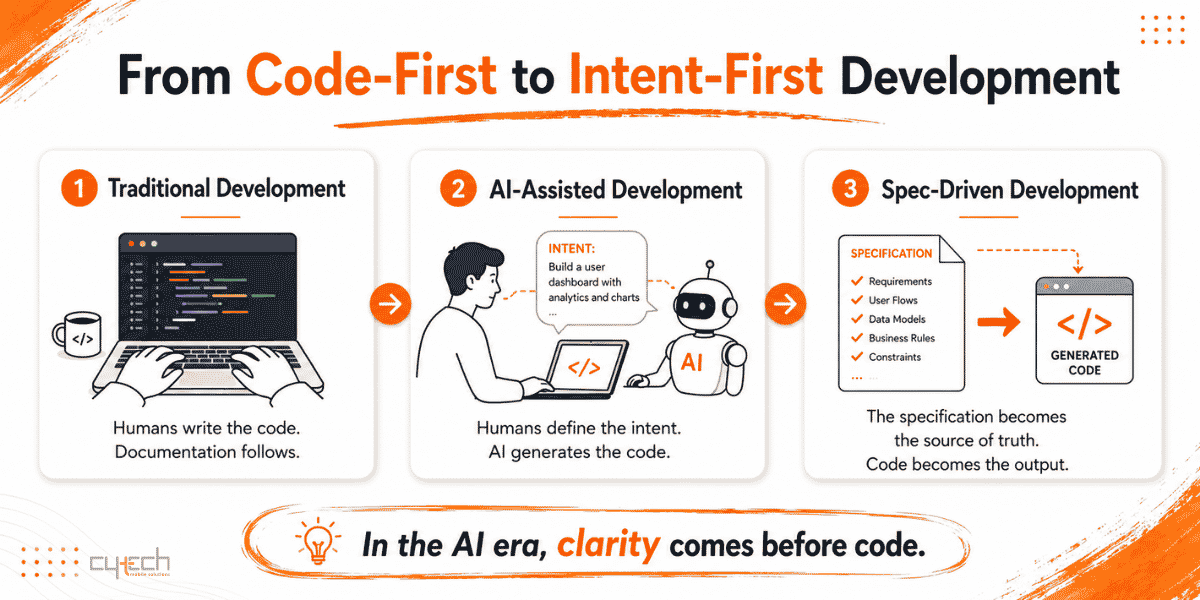
AI coding assistants have changed the way software is built. Developers no longer spend all their time writing every line manually. Instead, they increasingly describe what they want, guide coding agents, review outputs, and integrate generated code into real products.
This shift has created a new question for software teams:
If AI can generate code, what becomes the most important part of software development?
The answer may no longer be the code itself. It may be the specification. This is the idea behind Spec-Driven Development, an approach where clear, structured specifications become the foundation that guides both human developers and AI coding agents throughout the development process.
From Vibe Coding to Engineering Control
In early 2025, the term “vibe coding” became popular as a way to describe a fast, prompt-driven development style. A developer gives an AI assistant a general instruction, reviews the output, adjusts the prompt, and continues iterating.
For prototypes, demos, and small internal tools, this approach can be useful. It speeds up discovery and helps teams move from idea to first version very quickly.
But when software moves into production, the limits become clear.
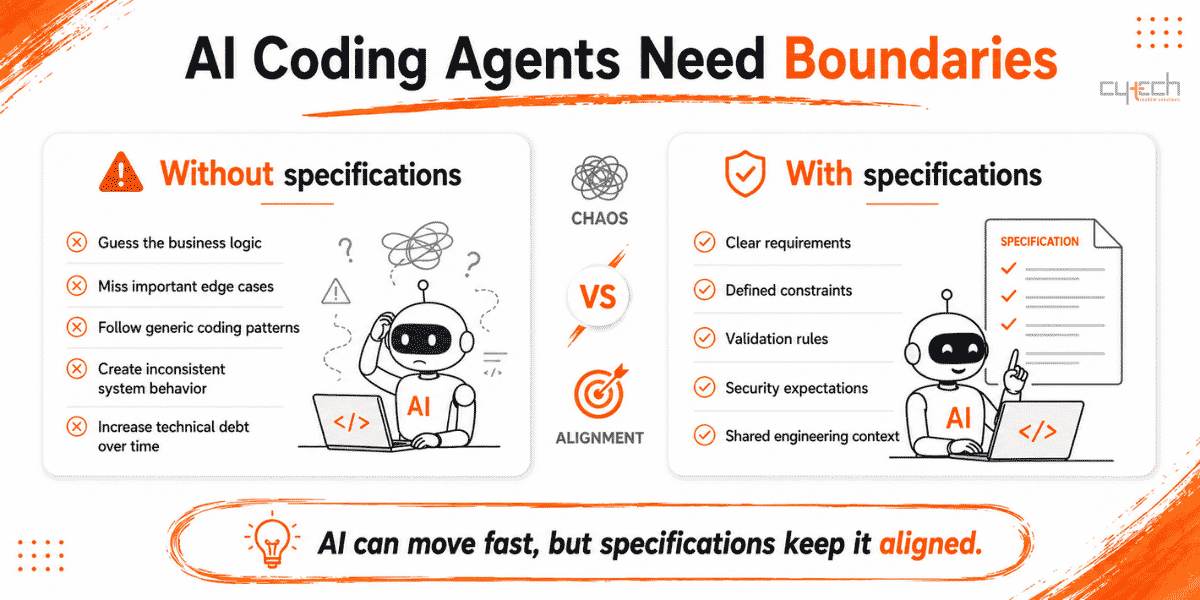
Unstructured prompts often lead to inconsistent logic, missing edge cases, security gaps, and architectural drift. AI agents do not truly understand the business context of a company unless that context is clearly provided. When requirements are vague, models fall back on generic patterns from their training data.
That is where Spec-Driven Development (SDD) becomes important.
SDD treats specifications as the primary source of truth. Instead of asking an AI model to “build a feature” based on a loose prompt, the team first defines the rules, constraints, expected behaviors, validation checks, APIs, and edge cases. The AI agent then uses that specification as a structured contract.
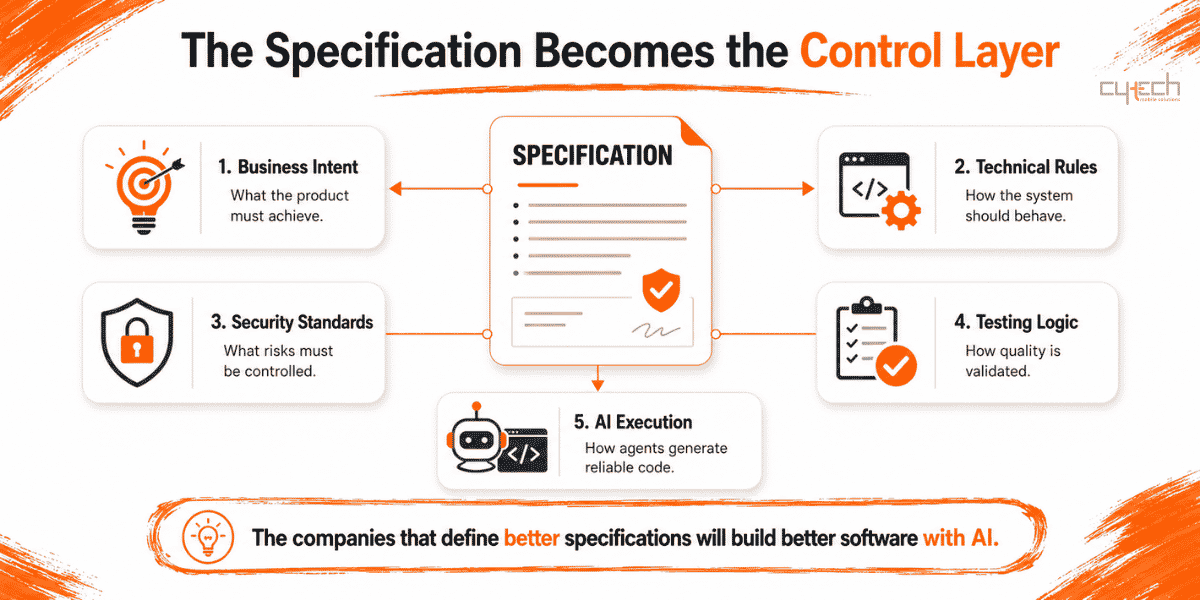
In this model, code becomes the output. The specification becomes the control layer.
Why Specifications Matter More in AI-Assisted Development
Traditional software development already relied on requirements, documentation, architecture diagrams, user stories, and test cases. But in many teams, these documents often became outdated once coding started.
AI changes the importance of this problem.
A human developer can ask follow-up questions, remember internal standards, understand hidden business logic, and notice when something “feels wrong.” An AI coding agent cannot reliably do that without persistent context.
Specifications give AI systems that context.
They define:
- what the system should do,
- what it should not do,
- how it should behave in edge cases,
- which standards it must follow,
- how outputs should be tested,
- and how changes should be validated.
This reduces the risk of “happy-path bias,” where generated code works only for the simplest scenario but fails under real-world conditions.
It also reduces “context collapse,” where AI agents lose track of project-specific requirements during long development sessions.
Key Statistics
| Topic | Statistic / Insight |
|---|---|
| AI-generated code quality | By 2026, empirical software research indicated that 62% of purely AI-generated code contained critical design flaws. |
| Security exposure | Third-party breach incidents reportedly doubled, increasing pressure for stronger engineering governance. |
| AI coding benchmark | On the June 2026 APEX-SWE benchmark, top-tier coding models reached 65.5% Pass@1, while GPT 5.3 Codex registered 41.5% Pass@1. |
| Productivity potential | Structured specifications paired with AI execution can deliver velocity gains of up to 150% compared with manual coding baselines. |
| Regulatory pressure | EU AI Act obligations starting in August 2026 include penalties of up to €35 million or 7% of global turnover for certain non-compliance cases. |
These numbers show the same pattern: AI can accelerate software development, but acceleration without structure creates risk.
How Specifications Guide Coding Agents
Coding agents work best when their search space is clearly defined. A good specification narrows the possible interpretations of a task and reduces the chance that the model will guess incorrectly.
For example, instead of writing:
“Create a user registration flow.”
A specification-driven approach would define:
- required fields,
- password rules,
- validation logic,
- database schema,
- API responses,
- error messages,
- security checks,
- test cases,
- and acceptance criteria.
This gives the AI agent a clear engineering boundary. It is no longer improvising. It is executing against a contract.
Tooling Frameworks Supporting SDD
| Tooling Framework | Origin / Launch | Architectural Focus | Primary Mechanism |
|---|---|---|---|
| GitHub Spec Kit | Microsoft, 2024 | Slash-commands in IDE | Markdown specs to structured tasks |
| AWS Kiro IDE | Amazon, May 2026 | Spec-native agent environment | File-to-spec workspace alignment |
| Tessl Framework | Guy Podjarny, Beta | Spec-as-source registry | Full code generation from specs |
| Specmatic | Open Source | API contract-driven testing | OpenAPI schema verification in CI |
These tools reflect a broader movement: software teams are trying to make AI coding more predictable, testable, and enterprise-ready.
The Three Levels of SDD Maturity
| Maturity Level | Definition and Strategy | Alignment Mechanism | Ideal Use Case |
|---|---|---|---|
| Spec-First | Specs are written upfront, then discarded or allowed to drift. | Upfront requirements guide the initial build phase. | Prototypes, throwaway scripts, single sessions. |
| Spec-Anchored | Specs and code coexist as continuously synchronized partners. | Automated testing, CI/CD checks, and contract validation. | Multi-contributor, long-lived production systems. |
| Spec-as-Source | Only the spec is edited; manual code modification is prohibited. | Automated full code and test suite regeneration. | Repetitive domains and strict compliance frameworks. |
For most production teams, Spec-Anchored development is likely the most practical model. It allows teams to benefit from AI speed while keeping specifications, tests, and code aligned.
The Risk of Over-Specification
SDD is not perfect.
If teams overuse it, they may recreate the slow, bureaucratic processes of old Waterfall development. Not every task needs a detailed specification. A small UI tweak, a temporary script, or an internal prototype may not justify heavy documentation.
The challenge is balance.
Specifications should be detailed enough to guide the AI, but not so heavy that they slow down delivery. The goal is not documentation for its own sake. The goal is engineering clarity.
Why This Matters for Software Companies
For software companies, the future advantage will not come only from using AI tools. Most competitors will have access to similar models.
The real advantage will come from how well teams structure their engineering process around those tools.
Companies that define clear specifications, maintain updated architecture rules, automate contract testing, and treat documentation as a living system will be able to use AI more safely and effectively.
Companies that rely only on fast prompting may ship quickly at first, but they risk accumulating technical debt, security issues, and inconsistent product behavior..
Conclusion
Spec-Driven Development does not mean that code is no longer important. Code still runs the product.
But in an AI-assisted development environment, code is increasingly becoming the output of a deeper system: the specification.
The specification captures business intent, technical constraints, compliance requirements, architecture standards, and validation rules. It tells both humans and machines what the software is supposed to be.
As AI coding agents become more powerful, the most valuable asset may not be the generated code itself.
It may be the structured knowledge that tells the code what to become.
Bibliography
- Spec-Driven Development: A Spec-First Approach to AI-Native Engineering
- From Vibe Coding to Spec-Driven Development
- Spec-driven development (SDD) with AI: Making agents enterprise ready
- Vibe Coding vs Spec-Driven Development: When to Use Each
- Vibe Coding vs Spec-Driven Development (2026): When to Use Each
- Specification-Driven Development: How to Stop Vibe Coding and Actually Ship Production-Ready AI-Generated Code
- Spec-Driven Development: From Code to Contract in the Age of AI Coding Assistants
- Spec-Driven Development: From Code to Contract in the Age of AI Coding Assistants
- Spec-Driven Development
- Specification-Driven Development (SDD)
- Spec-Driven Development with Coding Agents
- Intro to Spec Driven Development: The Structured Way to Build Large Applications with AI
- Scaling AI Coding Agents Through Automated Verification and Specification-Driven Development
- Understanding Specification-Driven Code Generation with LLMs: An Empirical Study Design
- Best AI models for software engineering (June 2026)
- Spec-Driven Development (SDD) — best practices (so far)
- Spec-Driven Development Explained: Why Pros Stopped Vibe Coding
- 4 cutting-edge tools for spec-driven development
- Spec-Driven Development is Better With Core Architecture
- Understanding Spec-Driven-Development: Kiro, spec-kit, and Tessl
- Specmatic
- specmatic 2.41.1
- The Three Levels of SDD
- Spec-First, Spec-Anchored, Spec-as-Truth: The Three Levels of Spec-Driven Development
- Using spec-driven development with Claude Code
- What is spec-driven development?
- Spec-Driven Development: Why Software Teams Need a Contract Before They Write Code
- Everything one should know about Spec-Driven Development (SDD)
- Spec-driven development: Turning AI speed into engineering control