


Table of Contents
In business messaging, reliability is not just a performance feature. It is a core requirement. Whether a company sends OTPs, banking alerts, delivery updates, appointment reminders, emergency notifications, or customer service messages, the communication must remain dependable even when the recipient’s device is offline, outside coverage, congested, or temporarily unavailable.
This is where SMS continues to stand out. Its resilience is not accidental. It is the result of a network architecture built around passive reliability.
Unlike active reliability models, where the application must constantly monitor status, manage retries, track failures, and execute recovery logic, SMS relies on the telecom network itself to preserve message state and recover automatically. Once an application submits a message to the carrier network through SMPP, routing, queue buffering, delivery attempts, and retry handling are managed at network level.
The Engineering Logic Behind Passive Reliability
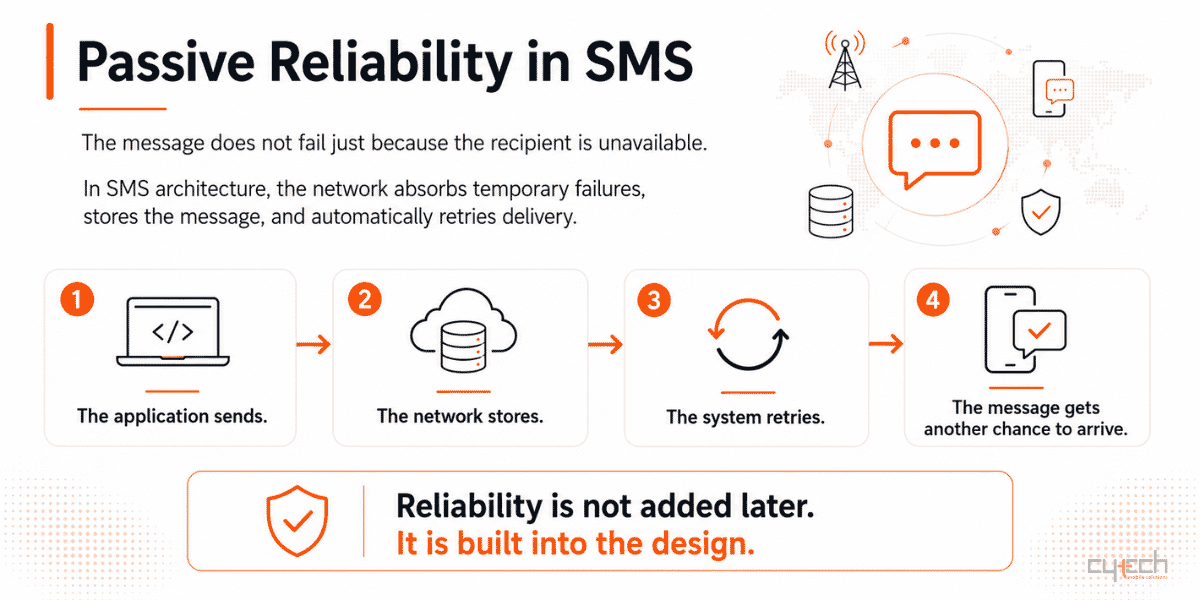
Passive reliability means that the system is designed to absorb temporary failures without requiring continuous client-side intervention.
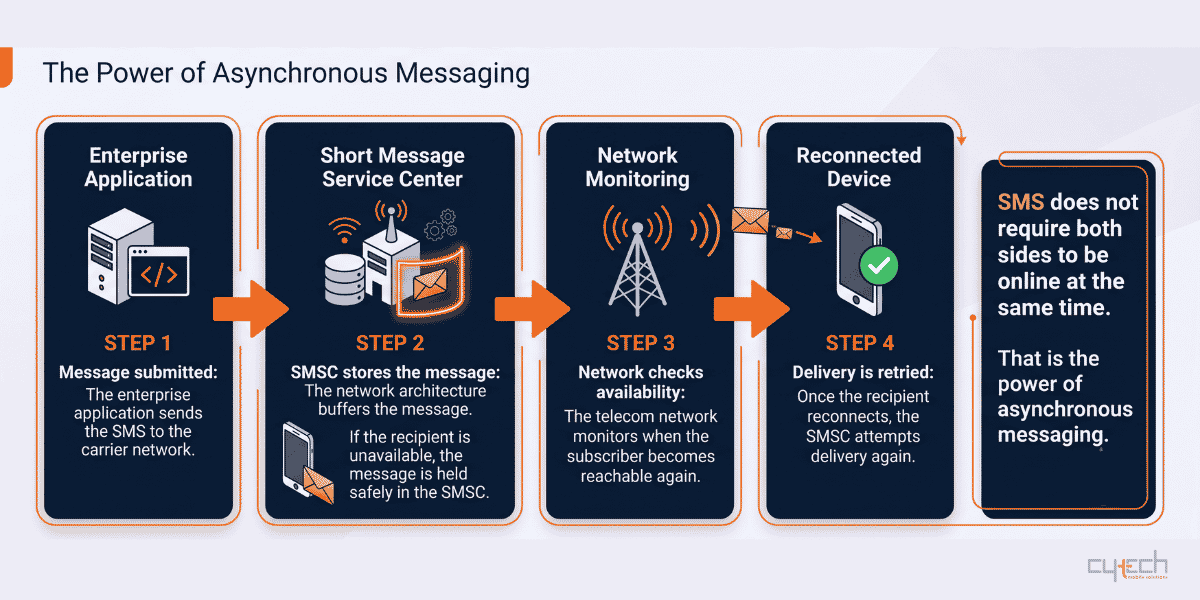
In SMS, this role is performed by the Short Message Service Center, or SMSC. The SMSC operates using a store-and-forward model. This means that message submission and message delivery are decoupled. The recipient does not need to be reachable at the exact moment the message is sent.
If the user’s phone is switched off, outside coverage, roaming, congested, or temporarily unreachable, the SMSC stores the message and retries delivery later. In many networks, the default message validity period is 72 hours, while 3GPP TS 23.040 allows validity configurations of up to 63 weeks.
This is one of the main reasons SMS remains highly reliable for asynchronous communication.
SMSC Store-and-Forward Architecture
The SMSC is the central buffer of the SMS ecosystem. It stores the message payload, priority, expiry timestamp, routing status, and delivery state. Modern SMSCs are designed for high availability, often deployed in geo-redundant active-active or active-standby configurations with real-time database synchronization.
This architecture protects messages from being lost during temporary network or subscriber failures.
In contrast to real-time session-based protocols, where communication may fail if both endpoints are not simultaneously available, SMS assumes that temporary unavailability will happen and handles it by design.
How Network-Level Routing Works
In a mobile-terminated SMS flow, the SMSC forwards the message to the SMS Gateway MSC. The SMS-GMSC then queries the recipient’s Home Location Register using MAP signaling to retrieve routing information. The HLR identifies the current serving MSC or SGSN and returns the address needed to forward the message.
If the recipient is available, the SMS is delivered. If not, the network classifies the failure and decides whether the message should be retried, suspended, or permanently terminated.
This classification is critical. A failed delivery attempt is not always a failed message.
Failure Classification and Network Handling
Temporary failures trigger retry and recovery mechanisms. Permanent failures stop the delivery process because retrying would not solve the issue.
Table 1: Classification and network-level handling of SMS failure states.
| Error Code | Classification | Cause Description | Retry Behavior |
|---|---|---|---|
| Error 27 / 153 | Temporary | Absent Subscriber — device off or out of coverage | Caches payload, updates HLR Message Waiting Data list, waits for network attachment |
| Error 31 | Temporary | Subscriber Busy for MT-SMS — congested visited MSC | Initiates immediate short-interval retry |
| Error 150 | Permanent | Unknown Subscriber — no directory number found | Terminates immediately, deletes message, reports hard failure |
| Error 151 | Permanent | Call Barred — operator-level restriction | Bypasses retry loop, drops message instantly |
| Error 152 | Permanent | Teleservice Not Provisioned — no SMS subscription | Hard failure, message immediately deleted from queue |
| Error 158 | Temporary | Memory Capacity Exceeded — full recipient storage | Registers MCEF flag, suspends delivery until storage clears |
When a delivery attempt fails because the subscriber is unavailable, the SMSC can trigger MAP_REPORT_SM_DELIVERY_STATUS. This updates the HLR with flags such as Mobile Not Reachable, Memory Capacity Exceeded, or Mobile Not Reachable for GPRS.
The HLR also stores the SMSC address in its Message Waiting Data list. When the subscriber becomes reachable again, for example after switching the phone back on or reconnecting to the network, the HLR sends an AlertSC message to the SMSC. This tells the SMSC to restart the delivery attempt.
Dual-Path Automated Recovery
SMS reliability is strengthened by two recovery paths working together.
The first is event-driven recovery. When the user returns to the network, the HLR alerts the SMSC and delivery resumes.
The second is time-based retry. The SMSC continues to retry delivery according to configured retry schedules. These schedules vary by carrier and platform, balancing delivery success against signaling load.
Table 2: Operational carrier retry schedules and retention profiles.
| Carrier / Platform | Default Validity Period | Retry Strategy Profile | Maximum Queue Retention |
|---|---|---|---|
| Orange | 72 hours | Immediate retry, followed by cascading intervals: 1m, 5m, 30m, 3×60m, 100×180m | 3 days |
| Telenet / Base | 72 hours | Continuous attempts using standard mobile-originated retry profiles | 7 days |
| RingRing | 48 hours | Technical: 5 attempts at 2m. No connection: 2m intervals for 15m, then 10m intervals | 4 hours standard fallback to 48h |
| SMPPCenter Smart Retry | Up to 24 hours | Intelligent backoff: 30s initial, 2m with random jitter, 8m with jitter, up to 5 attempts | 24 hours |
Advanced retry logic can also use jitter, which slightly randomizes retry timing. This reduces retry spikes and prevents unnecessary signaling congestion when large volumes of messages fail at the same time.
The Reliability Impact
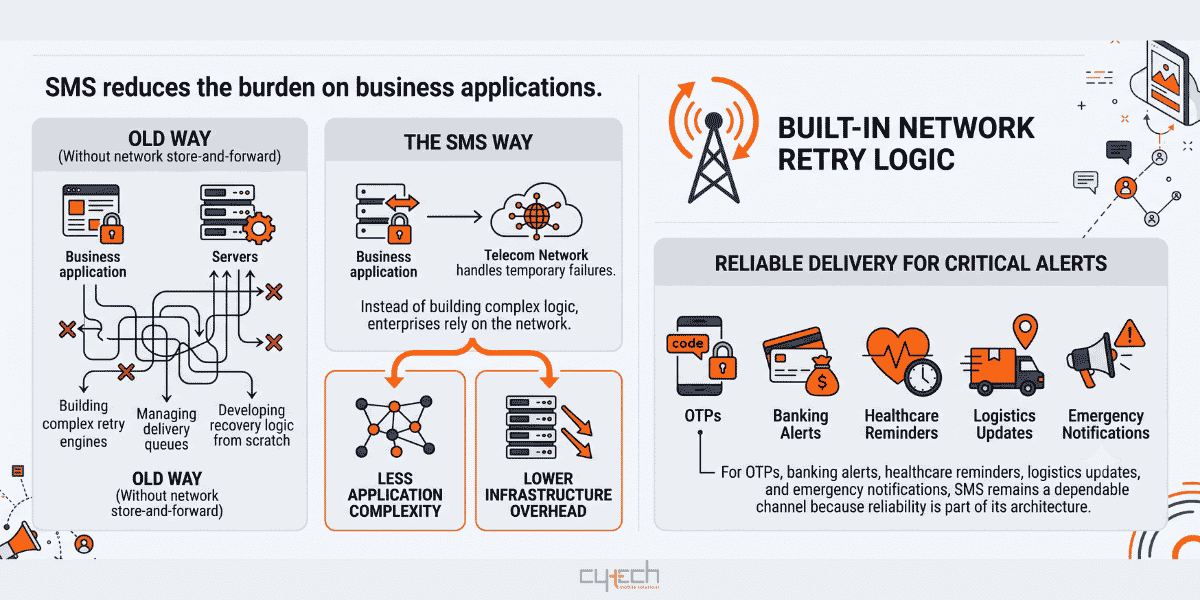
This passive reliability model allows SMS to achieve strong delivery performance without forcing enterprise applications to build telecom-grade retry systems themselves.
Standard SMS delivery success rates are often estimated at 85%–92%, depending on the use case, geography, operator conditions, and number quality. When enhanced with smart retry mechanisms, optimized routing, and jittered retry logic, delivery success can rise to 96%–98%.
For enterprises, this matters because it reduces infrastructure complexity. The sending application does not need to constantly poll recipient availability, maintain complex retry queues, or design custom recovery algorithms for every temporary network failure.
Instead, much of this logic is handled by the telecom infrastructure.
Why This Still Matters
SMS is one of the oldest mobile communication technologies, but its reliability model remains highly relevant. Store-and-forward delivery, network-level retry, subscriber status awareness, message validity periods, and high-availability SMSC infrastructure continue to make SMS one of the most dependable channels for asynchronous communication.
As messaging evolves toward RCS, M2M, IoT, and automated global alerting, the core engineering lesson remains the same: reliability should be built into the architecture, not added afterwards.
For businesses, this is the real value of SMS.
It is not only simple.
It is structurally reliable.
Bibliography
- Passive Safety System Reliability
- Reliability assessment of passive safety systems
- A Review: Passive System Reliability Analysis – Accomplishments and Unresolved Issues
- Reliability analysis for passive systems – A case study on a passive containment cooling system
- SMSC (Short Message Service Center)
- Short Message Service Center (SMSC)
- What is SMSC?
- Short Message service center
- Error 27: Absent Subscriber
- Short Message Service technical realisation (GSM)
- GSM 03.40
- Short Message Service technical realisation (GSM)
- Terms and definitions in messaging
- Resolving “unknownSubscriber” Error in SMS Delivery
- Delivery Failure and SMS Error Codes
- How many attempts do we take to deliver a message?
- Smart Retry Mechanisms: Maximizing SMS Delivery Success Rates
- Message retries (store-and-forward)