

Table of Contents
Enterprise messaging has become a critical part of how businesses communicate with customers. SMS is now used for authentication, transactional alerts, customer service, appointment reminders, marketing, and time-sensitive notifications.
At the center of this ecosystem is an important distinction between Person-to-Person (P2P) and Application-to-Person (A2P) messaging.
P2P messaging refers to direct conversations between individual consumers. A2P messaging, by contrast, includes messages generated or initiated by software, APIs, CRM systems, messaging platforms, or other automated applications.
In practical terms, most commercial SMS traffic is classified as A2P. Understanding this difference is essential because it directly affects compliance, carrier approval, message throughput, deliverability, cost, and scalability.
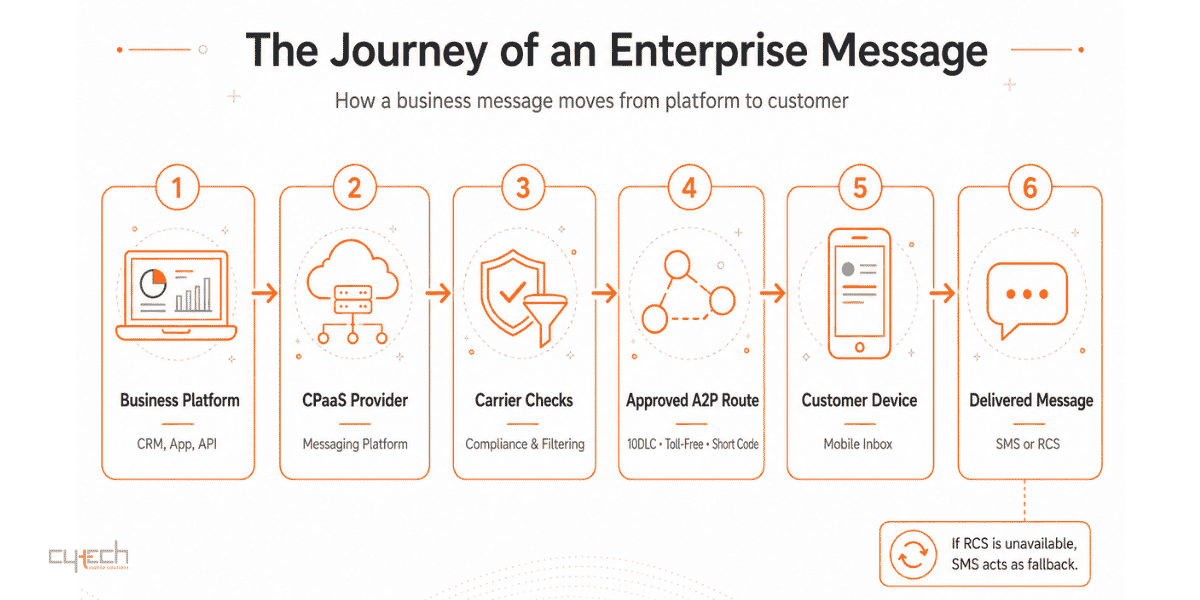
How Carriers Distinguish P2P from A2P
In 2019, the Cellular Telecommunications Industry Association (CTIA) clarified that P2P messaging should primarily represent genuine communication between individual consumers. Businesses sending automated or commercial messages are therefore expected to use approved A2P routes.
Mobile network operators analyze traffic behavior to distinguish normal consumer communication from automated business messaging. They examine factors such as message volume, throughput, recipient distribution, response patterns, and repetitive content.
Table 1. Key Differences Between P2P and A2P Messaging
| Metric | Typical P2P Traffic | Typical A2P Traffic |
|---|---|---|
| Throughput | Usually 15–60 messages per minute | Can exceed 1 message per second |
| Daily Volume | Generally below 1,000 messages | Sustained high-volume messaging |
| Conversation Pattern | Relatively balanced incoming and outgoing messages | Mostly outbound communication |
| Recipients | Limited number of individual contacts | Large, programmatically managed audiences |
| Content | Organic and varied | Often standardized or repetitive |
| Primary Use | Personal conversations | OTPs, alerts, support, reminders, marketing |
Carriers also monitor practices such as snowshoeing, where senders distribute one campaign across multiple phone numbers to avoid volume controls or spam detection. This can lead to filtering, blocking, and sender blacklisting.
For businesses, the message is clear: commercial traffic should use properly registered A2P infrastructure rather than consumer P2P routes.
Compliance and Risk Management
Compliance is a fundamental part of any enterprise messaging strategy, especially in the United States.
Businesses must consider regulations such as the Telephone Consumer Protection Act (TCPA), CTIA guidelines, carrier policies, and consent requirements.
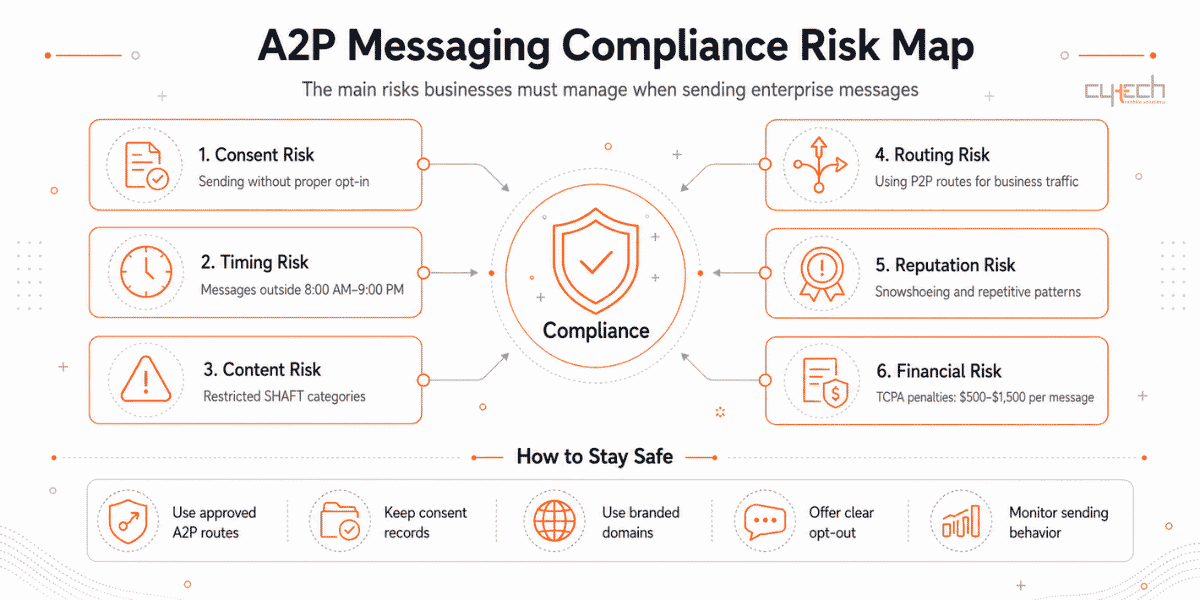
The level of consent depends on the type of communication. Conversational messages may operate under implied consent, while informational alerts generally require express consent. Promotional or marketing messages usually require stronger, documented authorization.
Organizations should therefore maintain clear consent records and provide simple opt-out mechanisms.
Timing also matters. Marketing messages are generally restricted to recipient-local hours between 8:00 AM and 9:00 PM.
Content restrictions are equally important. US carriers apply strict controls to high-risk categories often summarized as SHAFT: Sex, Hate, Alcohol, Firearms, and Tobacco.
Public URL shorteners such as bit.ly can also create deliverability problems because carrier filters may treat them as potential spam or phishing signals. Branded and verified domains are generally safer.
The financial consequences of non-compliance can be severe. Under the TCPA, statutory damages may range from approximately $500 to $1,500 per non-compliant text message, depending on the circumstances.
Compliance is therefore not only a legal obligation. It is also essential for protecting sender reputation, delivery rates, and customer trust.
Choosing the Right A2P Messaging Route
Businesses operating in North America generally choose between three major carrier-approved A2P pathways: 10-Digit Long Code (10DLC), Toll-Free Messaging, and Short Codes.
Each option provides a different balance of throughput, cost, provisioning speed, branding, and functionality.
Table 2. Comparison of Major A2P Messaging Pathways
| Parameter | A2P 10DLC | Toll-Free | Short Code |
|---|---|---|---|
| Format | Standard 10-digit local number | 8XX number | 5- or 6-digit number |
| Throughput | Approx. 3–180 MPS | Approx. 3–150+ MPS | Approx. 100–500+ MPS |
| Provisioning | Around 3–5 weeks | Around 7–21 days | Around 6–10 weeks |
| Voice Support | Yes | Yes | No |
| Best Use Cases | Support, reminders, local campaigns | National customer service and messaging | OTPs, alerts, large-scale campaigns |
| Main Strength | Familiar local presence | Nationwide voice and SMS identity | Very high throughput |
10DLC is well suited to local engagement, customer support, appointment reminders, and targeted campaigns. It combines SMS with voice capabilities and uses familiar local numbers.
Toll-Free Messaging is useful for national customer service and business communication, especially when organizations want one recognizable number for both voice and SMS.
Short Codes offer the highest throughput and are commonly used for large-scale authentication, OTP delivery, flash alerts, and high-volume campaigns. However, they normally involve higher costs and longer provisioning periods.
The correct choice depends on the organization’s volume, urgency, geographic reach, budget, and customer experience requirements.
The Financial Reality of A2P Messaging
Enterprise messaging costs involve much more than the advertised price per SMS.
Businesses must consider number rental, registration, campaign approval, carrier surcharges, platform fees, and per-message costs.
For US 10DLC messaging, brand and campaign registration through The Campaign Registry (TCR) has become an important part of the ecosystem.
Pricing differences between CPaaS providers can also become significant at scale.
Indicative base outbound US SMS rates have included approximately:
- Twilio: $0.0083 per segment
- Plivo: $0.0055 per segment
- Telnyx: $0.0040 per segment
These rates generally exclude carrier fees and additional surcharges.
Carrier costs can materially change the final price. In January 2026, for example, T-Mobile increased certain outbound SMS surcharges to approximately $0.0045 per message segment across major messaging channels.
At low volumes, these differences may appear minor. At millions of messages per month, however, fractions of a cent can translate into substantial annual expenses.
Businesses should therefore evaluate total cost of ownership rather than simply comparing headline API prices.
Routing quality, carrier connectivity, delivery reporting, fraud prevention, scalability, compliance support, and platform flexibility can be just as important as the base message rate.
The Rise of RCS and Conversational Messaging
Enterprise messaging is also moving beyond traditional one-way SMS campaigns.
Rich Communication Services (RCS) is accelerating this transition by bringing app-like functionality directly into the native messaging inbox.
Following Apple’s support for RCS with iOS 18, the technology gained significantly broader reach.
RCS allows businesses to deliver richer experiences through verified sender identities, high-resolution media, interactive buttons, product carousels, suggested replies, and conversational customer journeys.
Some industry surveys have reported that approximately 81% of consumers prefer RCS experiences over traditional SMS, while rich-media messaging campaigns have reported 60% to 70% higher conversion rates in certain use cases.
However, RCS should not be viewed as a replacement for SMS.
The strongest enterprise strategy combines both.
Modern messaging platforms increasingly use channel orchestration, sending an RCS message when the recipient and network support it, while automatically falling back to standard A2P SMS when necessary.
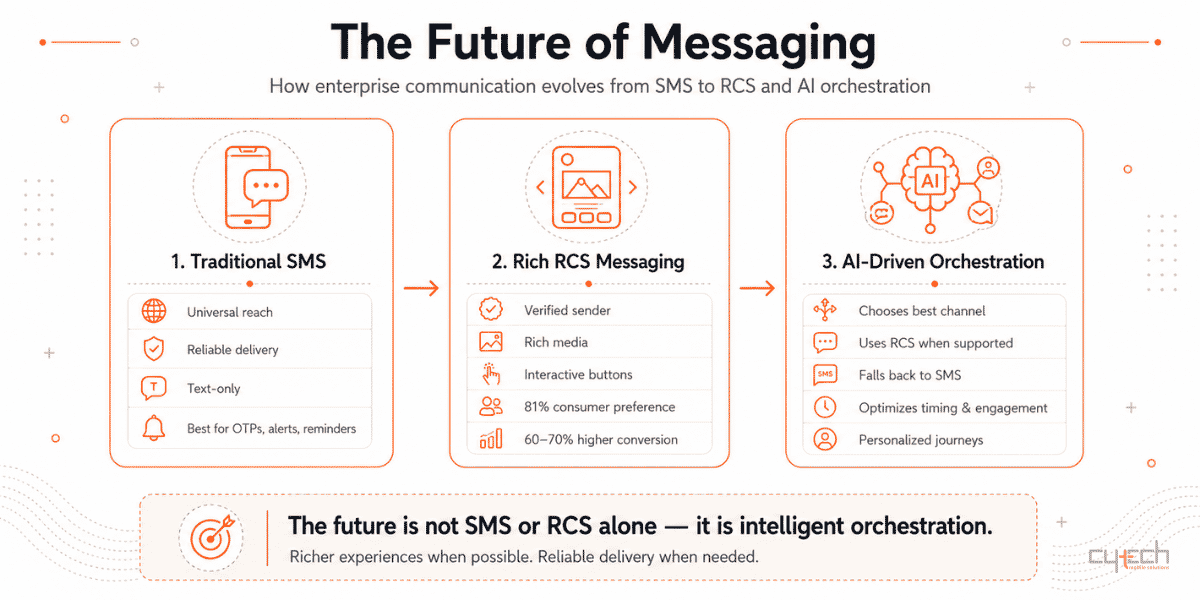
This provides the richer experience of RCS without sacrificing the reach and reliability of SMS.h slightly randomizes retry timing. This reduces retry spikes and prevents unnecessary signaling congestion when large volumes of messages fail at the same time.
Building a Smarter Messaging Strategy
The future of enterprise messaging will not depend on one protocol alone.
Businesses need communication infrastructures that can intelligently choose the right channel based on customer context, consent, urgency, device compatibility, cost, and deliverability.
AI-driven orchestration will further strengthen this model by helping platforms interpret customer behavior, engagement, sentiment, and communication preferences.
The goal is no longer simply to send more messages.
It is to deliver the right message, through the right channel, at the right time, with the right level of compliance and reliability.
A2P SMS will remain a critical foundation because of its global reach and accessibility. RCS will provide richer and more interactive customer experiences.
Together, intelligent routing, APIs, carrier-approved messaging pathways, and conversational technologies are transforming enterprise messaging from simple text delivery into a scalable, secure, and integrated customer engagement ecosystem.
Bibliography
- A2P vs P2P Messaging: The Ultimate Guide to Commercial Communication Differences
- Demystifying the US Messaging Ecosystem: Part 2: Understanding A2P and P2P Messaging: A Deep Dive into the Messaging Matrix
- 10DLC Registration & Compliance: The Complete Guide for U.S. Business SMS 2026
- A2P 10DLC Compliance
- A2P 10DLC Registration in 2026: Agency Step-by-Step Guide (Avoid $10K Carrier Fines)
- What Is A2P Messaging? How It Works and Why Businesses Use It
- SMS Messaging Regulations in the United States
- SMS Deliverability Best Practices: The 2026 Guide to High-Impact Outreach
- Text Messaging SPAM
- What is A2P 10DLC, Short Codes, and Toll-Free Messaging
- CTIA’s Updated 2023 Messaging Principles and Best Practices
- CTIA Messaging Guidelines & Pre-Send Checklist
- USA | SMS compliance & best practice
- Telephone Consumer Protection Act Compliance in 2025:A Complete Guide
- Understanding the FCC one-to-one consent rule update
- SMS Marketing Laws: TCPA, CTIA & 10DLC Compliance Guide (2026)
- The FCC Delays Effective Date of TCPA Revoke-All Rule Until January 31, 2027
- FCC Further Extends Effective Date for TCPA “Revoke-All” Rule
- Burdensome Portion of TCPA Rule Delayed Through April 2026
- What are the differences between long codes (A2P 10DLC), short codes, and Toll-Free numbers for messaging to US/Canada?
- Number comparison twilio
- A2P 10DLC Registration and SMS Compliance: The Complete Guide for 2026
- 10DLC vs. Short Codes vs. Toll-Free Messaging
- 10DLC vs toll-free vs short code: Choose the right number type
- A2P 10DLC Compliance: The 2025 Guide for Business SMS
- 10DLC Vs Toll-Free Vs Short Code
- Pricing and Fees for A2P 10DLC Service
- A2P 10DLC Fees Explained: Registration, Monthly and Carrier Costs (2026)
- A2P 10DLC Brand Registration
- Plivo Pricing: Plans, Costs & What You’ll Actually Pay
- Twilio SMS API cost: complete pricing breakdown for 2026
- New Requirements for A2P 10DLC Registrations
- T-Mobile Messaging Carrier Fee Changes (January 2026)
- Best 2FA API for SMS Verification in 2026
- Twilio vs Plivo vs Telnyx: SMS & Voice APIs 2026
- Customer Experience Blog
- Why Business Messaging Is the Engine of Digital Engagement in 2026
- Conversational Use Cases Fuel Global Messaging Boom: Nearly 3 Trillion Business Messages by 2030
- A2P messaging trends for 2026
- A2P SMS MARKET SIZE & SHARE ANALYSIS – GROWTH TRENDS AND FORECAST (2026 – 2031)