

Table of Contents
On May 31st, Sendium officially launched, opening a new chapter for open, transparent, and community-driven SMS infrastructure.
Sendium was created for developers, telecom engineers, messaging professionals, DevOps teams, system integrators, enterprises, CPaaS providers, SaaS platforms, and open-source contributors who need more control over the way SMS traffic is sent, routed, monitored, and delivered.
At a time when digital systems are becoming more complex, distributed, and cloud-native, messaging infrastructure needs to evolve as well. SMS remains one of the most important communication channels in the world, supporting authentication, alerts, notifications, customer communication, operational updates, and critical business workflows across industries. Yet, much of the infrastructure behind SMS has not evolved at the same pace as the applications and platforms it now supports.
That is why Sendium was built.
Why SMS Infrastructure Needs to Evolve
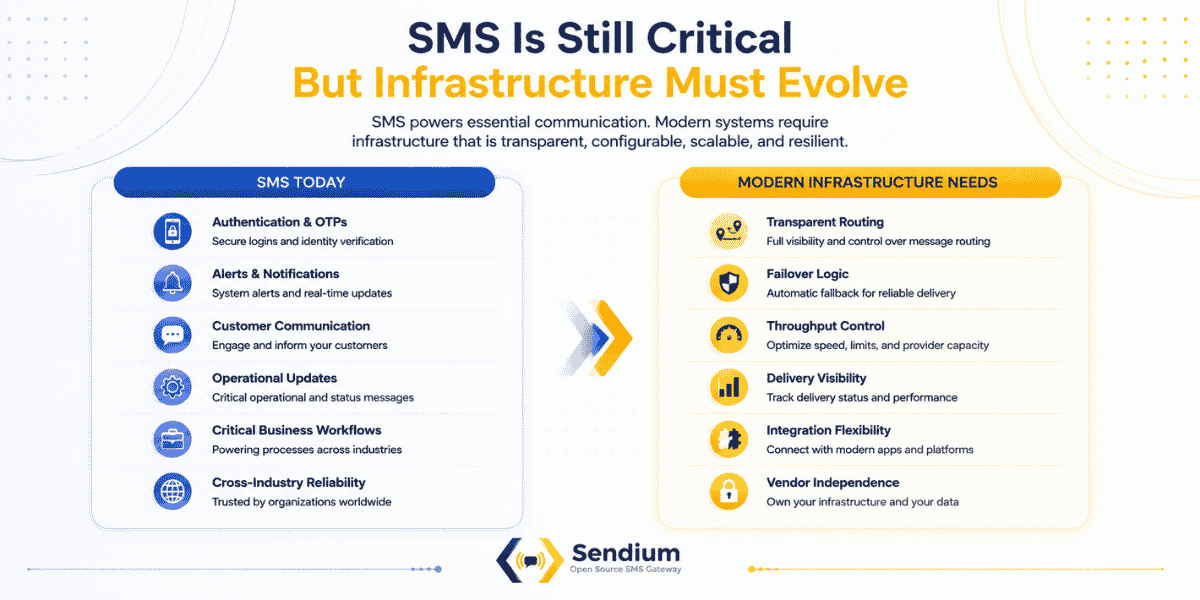
For many organizations, SMS is no longer just a simple communication feature. It is part of essential digital infrastructure.
Banks use SMS for one-time passwords and transaction alerts. Enterprises use it for customer communication and operational notifications. Platforms use it for account verification, reminders, alerts, and service updates. Public organizations, logistics providers, healthcare systems, and digital services all rely on SMS to deliver important information quickly and reliably.
However, the systems behind SMS delivery are often closed, difficult to configure, and limited in visibility. Many teams depend on black-box platforms where routing logic, provider behavior, delivery performance, and infrastructure decisions are not fully transparent.
This creates challenges for technical teams that need greater control, reliability, and flexibility.
Modern messaging infrastructure should allow teams to understand how messages are routed, how providers perform, how throughput is managed, how failover works, and how delivery reports are handled. It should support integration with modern applications, while also respecting the technical realities of telecom environments.
This product was designed to address exactly this need.elivery through srcset improves device-specific loading. Native lazy loading and explicit image dimensions also help maintain strong LCP and CLS scores.
What Is Sendium?
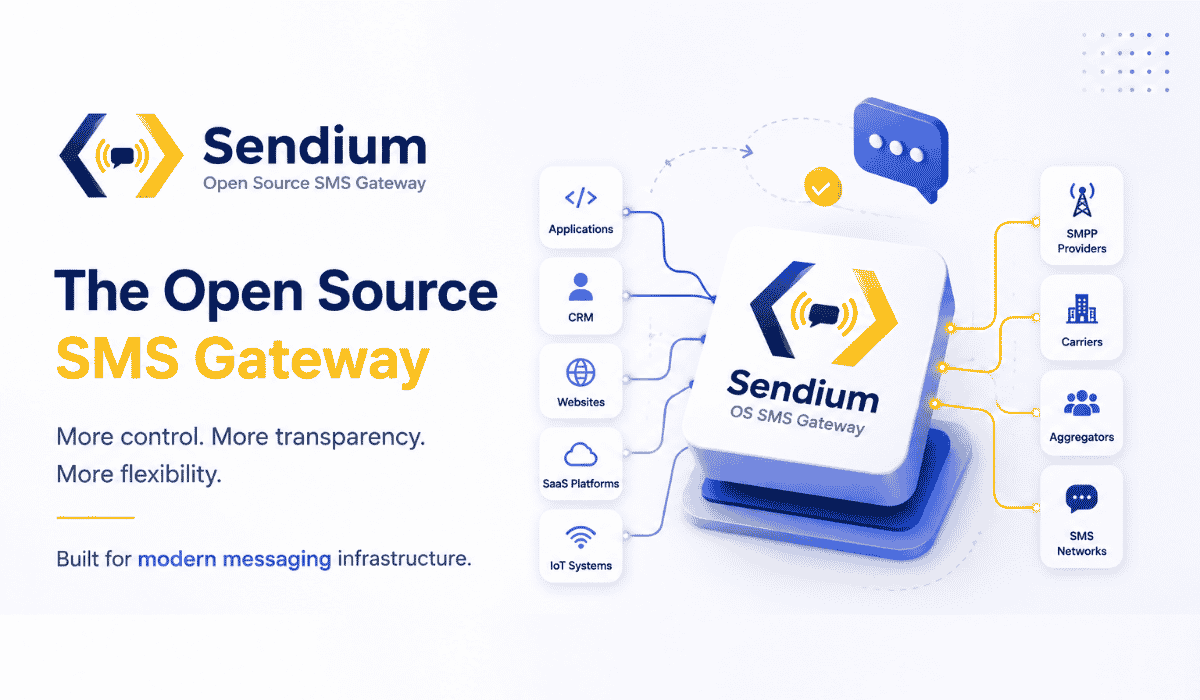
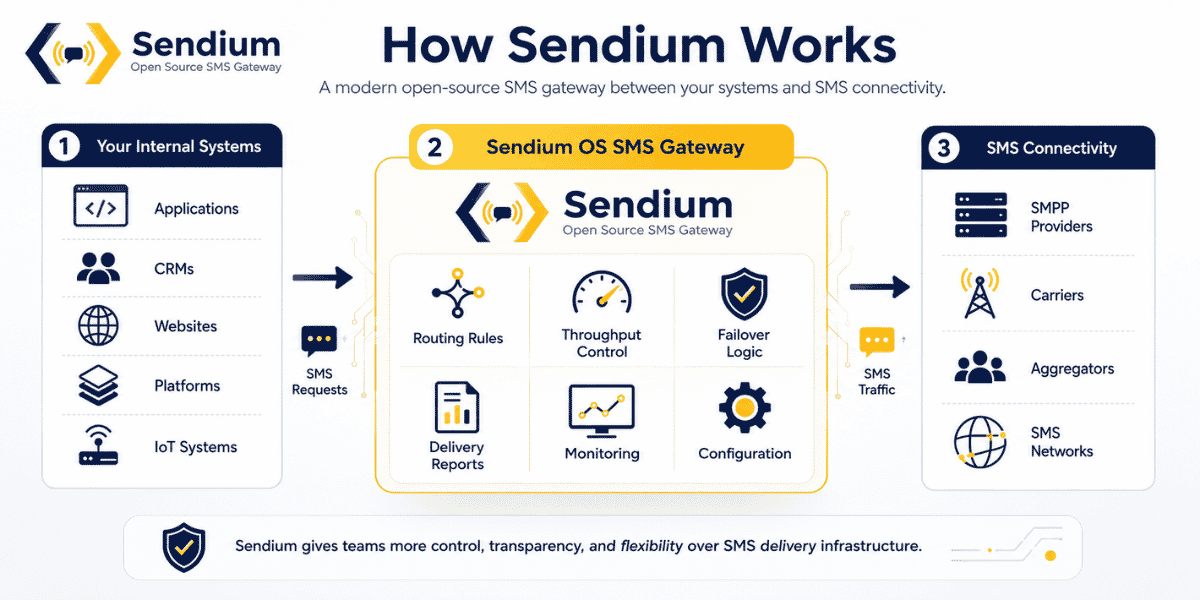
Sendium is an open-source, headless SMS gateway designed to sit between internal systems and SMS connectivity providers.
In simple terms, connects applications, CRMs, websites, platforms, SaaS tools, enterprise systems, and IoT environments with SMS providers such as carriers, aggregators, and SMPP connections.
Its purpose is to give teams greater ownership over their SMS infrastructure.
Instead of relying entirely on closed messaging platforms, Sendium provides a gateway layer that can be deployed, inspected, configured, extended, and operated according to real infrastructure needs.
It helps technical teams manage how messages move through their systems, how providers are used, how delivery behavior is monitored, and how routing decisions are made.
Built for Control, Transparency, and Flexibility
Sendium was built for organizations and technical teams that need more than basic SMS forwarding.
It supports modern messaging workflows while bridging the gap between HTTP-based systems and SMPP connectivity. This makes it especially relevant for environments where SMS is part of critical operations and where delivery performance, routing behavior, and infrastructure visibility matter.
With This product, teams can work towards a more transparent and configurable SMS setup. They can manage routing rules, control throughput, handle delivery reports, support failover logic, and build more resilient message delivery strategies.
This is particularly important for teams that need to avoid unnecessary vendor lock-in and want greater control over their messaging stack.
Sendium gives organizations the ability to treat SMS infrastructure as something they can understand, operate, and improve — not simply as an invisible external service.
Who Is Sendium For?
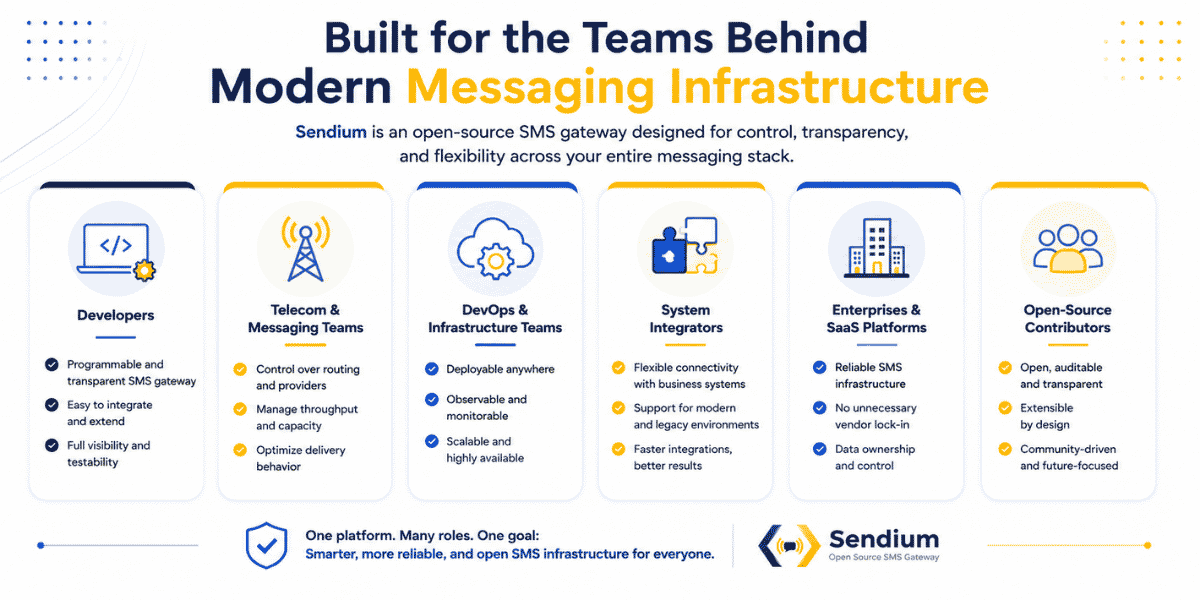
Sendium was created for a wide range of technical and business users working across messaging, telecom, software, and infrastructure environments.
It is for developers who want a programmable and transparent SMS gateway.
It is for telecom and messaging teams that need more control over routing, providers, throughput, and delivery behavior.
It is for DevOps and infrastructure teams that prefer systems they can deploy, observe, configure, and scale.
It is for CPaaS providers, SaaS platforms, enterprises, and system integrators that need flexible SMS infrastructure without unnecessary vendor lock-in.
It is also for the open-source community — people who believe that important infrastructure becomes stronger when it is open, auditable, extensible, and shaped by real-world users.
Why Open Source Matters
Messaging infrastructure is often treated as something invisible. It works quietly in the background, and when everything goes well, few people think about it.
But for the people who build, maintain, and depend on messaging systems, the details matter.
Routing decisions matter.
Delivery visibility matters.
Failover matters.
Throughput matters.
Data ownership matters.
Vendor independence matters.
Open-source infrastructure helps bring these conversations into the open.
With Sendium, technical teams and contributors can inspect how the gateway works, understand its logic, adapt it to their needs, and contribute improvements based on real-world use cases. This creates a stronger foundation for collaboration and innovation around SMS gateway technology.
The launch of Sendium is therefore not only the release of a new open-source SMS gateway. It is also the beginning of a community.
Building the Sendium Community
From the beginning, Sendium was designed as a community-driven project.
The goal is to create a space where people working with messaging infrastructure can exchange knowledge, ask questions, discuss routing challenges, share use cases, suggest improvements, contribute code, and help shape the future of open SMS gateway technology.
If you are interested in SMS gateways, SMPP, A2P messaging, routing logic, delivery receipts, failover strategies, cloud-native telecom infrastructure, or open-source messaging tools, Sendium is built for you.
The project is now live, and the community is open.
You can explore Sendium through the official website: https://www.sendium.org
You can also join the Sendium communities and follow the project across our channels:
- Facebook Group: https://www.facebook.com/groups/1141585701295655/
- LinkedIn Group: https://www.linkedin.com/groups/15778094/
- GitHub Repository: https://github.com/cytechmobile/sendium
Whether you want to test Sendium in your own environment, follow the documentation, contribute to the codebase, ask technical questions, share feedback, or simply be part of the conversation, now is the right moment to get involved.
Sendium has officially launched.
Now, the real journey begins — with users, contributors, feedback, adoption, and an open community around modern SMS infrastructure.
Welcome to Sendium.
Welcome to the community.