

Table of Contents
In the hyper-connected landscape of 2026, the “silent pulse” of the global economy isn’t found in flashy social media feeds or viral videos. Instead, it lives in the unassuming pings of your mobile device. This is the world of Application-to-Person (A2P) messaging.
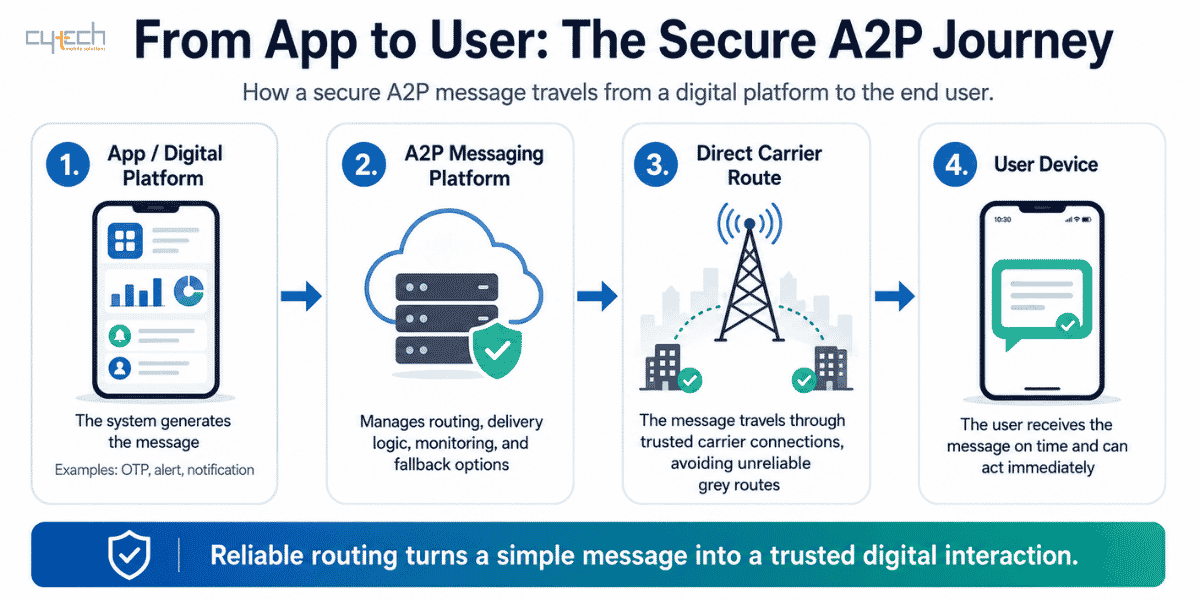
While we often take it for granted, the seamless flow of information from software applications to human beings is what keeps our digital lives secure and our schedules on track. At the core of this ecosystem are three distinct but interconnected pillars: One-Time Passwords (OTPs), Real-Time Alerts, and Functional Notifications. Together, they form the essential backbone of secure A2P communication.
1. OTPs: The Digital Handshake
The One-Time Password (OTP) has evolved from a secondary security measure into a non-negotiable standard for identity verification. As static passwords become increasingly obsolete due to sophisticated phishing and brute-force attacks, the OTP acts as a dynamic, time-sensitive “handshake” between a user and a service.
The Security Mechanics
The power of the OTP lies in its entropy and expiration. By generating a unique string of digits—delivered via SMS, voice, or encrypted data channels—businesses ensure that even if a user’s primary credentials are stolen, the account remains inaccessible without physical access to the user’s device.
- Multi-Factor Authentication (MFA): In 2026, MFA is no longer an “opt-in” feature for most financial and enterprise platforms; it is the default.
- Flash Calls & Silent Authentication: We are seeing a rise in “Flash Calls” (where a missed call acts as the code) and “Silent Auth” (using SIM-based telemetry) to reduce friction while maintaining high security.
The Latency Trap: For an OTP, speed is security. If a code takes 60 seconds to arrive, the user’s session may time out, leading to “transaction abandonment.” High-quality A2P infrastructure ensures these codes travel via direct carrier routes to minimize delay.
2. Alerts: The Proactive Watchdog
If OTPs are the gates to the castle, Alerts are the sentries on the walls. Alerts are transactional, time-critical messages triggered by specific events. Their primary goal is risk mitigation and immediate awareness.
Critical Use Cases
- Fraud Prevention: An SMS stating, “Did you just spend $1,200 in a city you’ve never visited?” is the first line of defense against credit card fraud.
- Account Integrity: Notifications about password changes, new device logins, or suspicious activity allow users to lock their accounts before damage occurs.
- Infrastructure Status: For the B2B sector, automated alerts regarding server downtimes or supply chain disruptions prevent minor glitches from cascading into major crises.
The psychological impact of alerts cannot be overstated. They build brand trust by proving to the customer that the company is watching over their interests in real-time.
3. Notifications: Navigating the Customer Journey
While OTPs and Alerts focus on security, Notifications focus on the Customer Experience (CX). These are the informative touchpoints that guide a user through a service lifecycle.
In an era of information overload, the “relevance” of a notification determines its value. Functional A2P notifications differ from marketing “spam” because they provide utility that the user has implicitly or explicitly requested.
Examples of High-Value Notifications:
- Logistics & E-commerce: “Your package is three stops away.”
- Healthcare: “Your prescription is ready for pickup at the pharmacy.”
- Travel: “Gate change: Your flight now departs from Gate B22.”
By automating these touchpoints, businesses significantly reduce the load on their customer support centers. A well-timed notification answers the question “Where is my order?” before the customer even thinks to ask it.
Comparing the Pillars: A Quick Reference
| Feature | One-Time Password (OTP) | Real-Time Alerts | Functional Notifications |
|---|---|---|---|
| Primary Goal | Identity Verification | Security & Risk Awareness | Convenience & Utility |
| Typical Urgency | Critical (Seconds) | High (Minutes) | Moderate (Minutes to Hours) |
| User Action | Required (Input Code) | Optional (Acknowledge) | Informational |
| Key Metric | Delivery Speed | Reliability | Open Rates / Engagement |
The Technical Infrastructure: Why Quality Matters
The “backbone” is only as strong as the routes it uses. Many businesses fall into the trap of using “Grey Routes”—unauthorized paths that exploit lower international rates but offer no guarantee of delivery or data privacy.
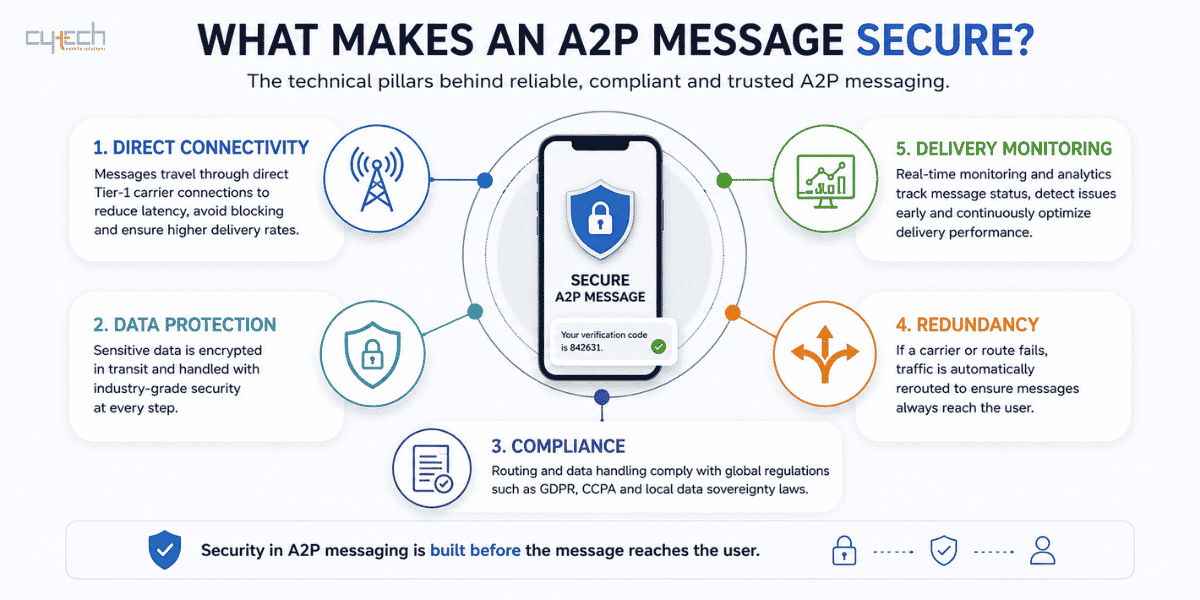
To maintain a secure A2P ecosystem, three technical requirements are paramount:
- Redundancy: If a specific carrier experiences an outage, a robust A2P platform must automatically re-route the traffic to ensure that a critical OTP still reaches the user.
- Direct Connectivity: Messages should travel through Tier-1 carrier interconnections to avoid being blocked by spam filters or lost in transit.
- Data Sovereignty & Compliance: With regulations like GDPR and CCPA, how a message is routed matters. Secure A2P providers ensure that sensitive data (like medical alerts or bank codes) is encrypted and handled according to local laws.
The 2026 Horizon: RCS and Beyond
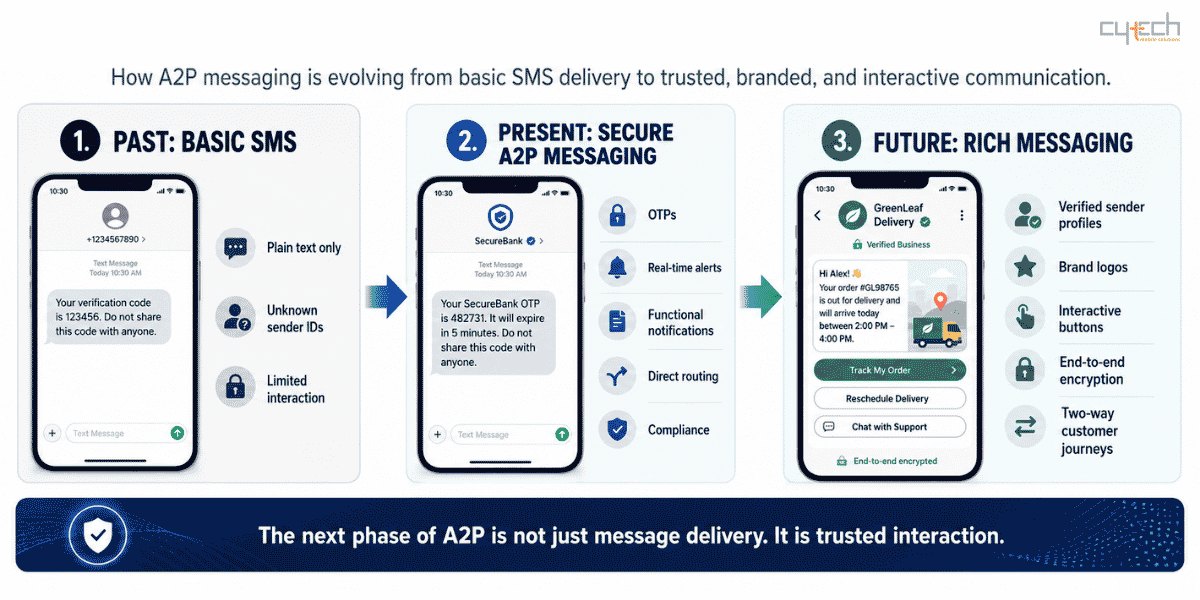
The future of the A2P backbone is moving toward Rich Communication Services (RCS) and WhatsApp Business. These protocols allow for:
- End-to-End Encryption: Moving beyond the standard telecommunications encryption to provide a level of privacy previously reserved for high-security apps.ategic value. They allow providers to start with SMS and expand into omnichannel messaging as market demand evolves.
- Verified Sender Profiles: Replacing mysterious short codes with branded logos and “verified” badges to eliminate phishing fears.
- Interactive Elements: Allowing users to “Confirm Appointment” or “Reschedule Delivery” with a single click inside the message interface.
Conclusion
OTPs, Alerts, and Notifications are far more than just “text messages.” They are the essential threads that weave security, trust, and convenience into the fabric of modern digital interaction. As businesses continue to scale their digital presence, the ability to deliver these messages reliably and securely remains the ultimate competitive advantage.
When the backbone is strong, the entire customer relationship stands firm.