


Table of Contents
Technology lifecycles have grown remarkably short, with industry data indicating that most software products face structural obsolescence within five years. In this rapid, highly volatile environment, future-proofing software has shifted from an idealistic practice to a core industry trend. Software development is an evolving field, and traditional organizations are increasingly abandoning static, heavyweight upfront planning in favor of adaptable, change-ready systems. Software architecture represents the decisions that are critical to system viability and exceptionally expensive to modify after construction has begun. Because predicting long-term business and tech trends is fundamentally difficult, designing for change is now recognized as a vital economic strategy for modern enterprises.
The Anatomy of Architectural Decay
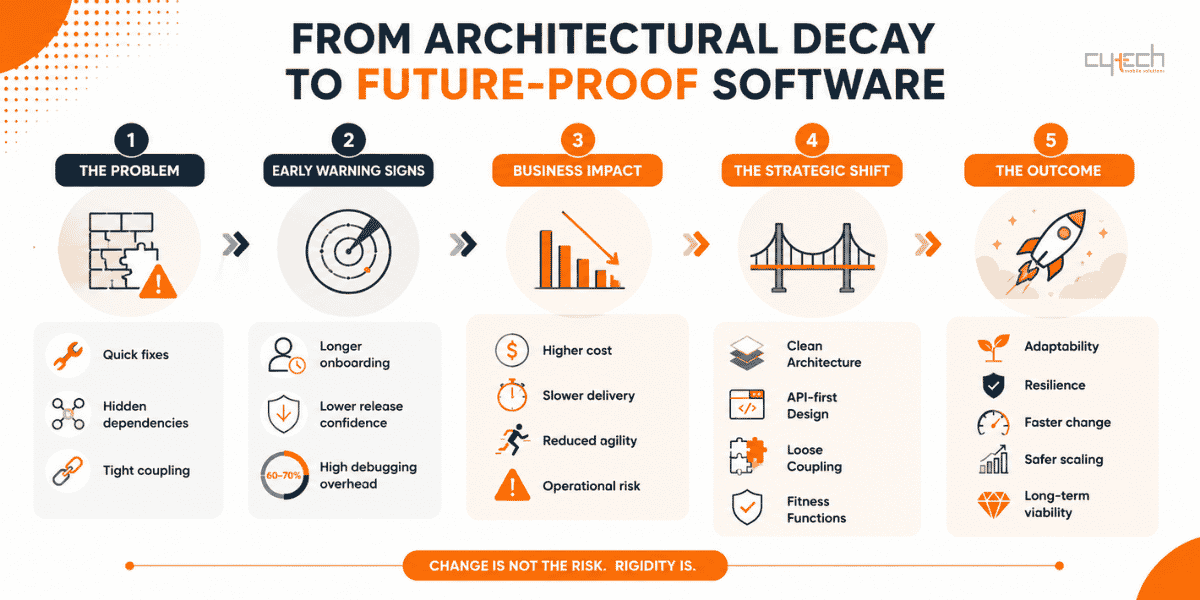
Architectural fragility rarely emerges from a single catastrophic mistake; instead, it accumulates through minor, locally optimized workarounds deployed over years. These shortcuts compound, creating dense networks of hidden dependencies that silently erode the engineering team’s capacity to comprehend system interactions. Structural decay is signaled early by an expanding “onboarding signal”—the time required for a new developer to contribute meaningful code—and a visible drop in release confidence. In highly rigid systems, developers spend approximately 60% to 70% of their total development time hunting and resolving bugs caused by tightly coupled code, in contrast to healthy codebases where debugging demands only 20% to 30% of their efforts.
| Quantitative Indicator / Event | Context and Industry Implications |
|---|---|
| Product Lifecycle | Most software products face technology obsolescence within a 5-year window. |
| Legacy Debugging Overhead | Rigid systems force developers to spend 60-70% of total effort on bug resolution, versus 20-30% in healthy codebases. |
| US Productivity Losses | Outdated, unstable technology wastes approximately $1.8 trillion annually in productivity. |
| Delta Reservation Failure (2016) | Sluggish legacy infrastructure crash grounded the airline’s entire fleet, generating a $150 million loss. |
| Southwest Scheduling Melt (2022) | Antiquated software (SkySolver) was unable to re-route crews during weather disruptions, causing over 16,900 flight cancellations. |
| Southwest Crisis Loss | The holiday meltdown resulted in total financial losses ranging from $1.1 billion to $1.2 billion. |
Reconciling the YAGNI and Future-Proofing Dilemma
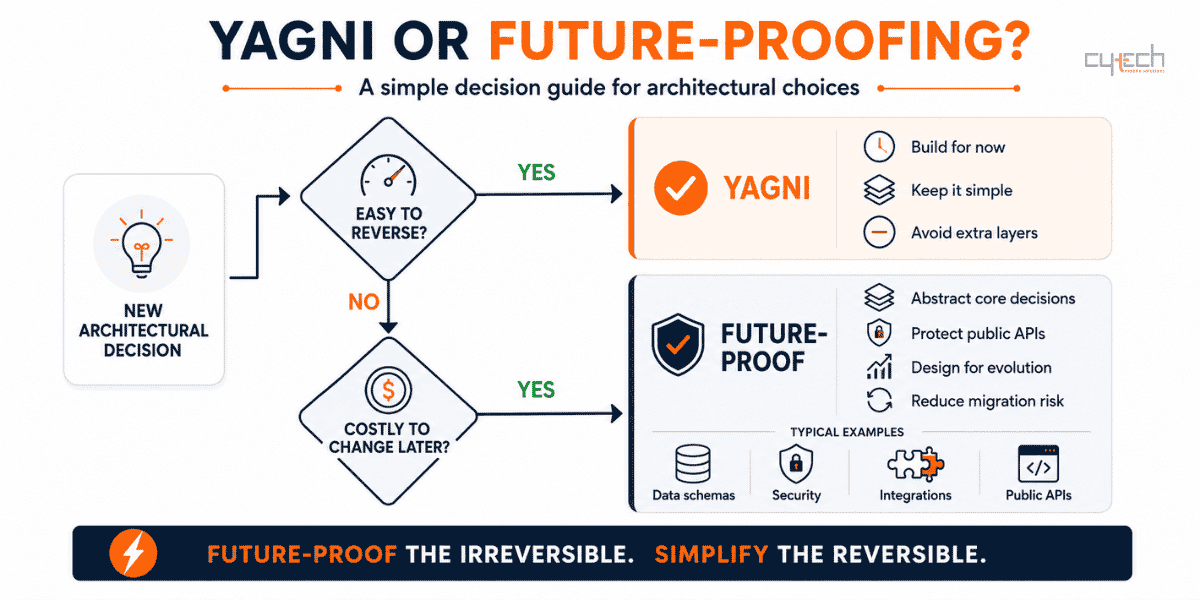
Software developers attempting to design for the unknown frequently struggle with the conflict between future extensibility and over-engineering. The “You Aren’t Gonna Need It” (YAGNI) principle states that features should only be built when a concrete requirements mandate exists, rather than when future utility is merely anticipated. Speculative abstractions generate immense code complexity, slowing release velocities and creating severe maintenance liabilities. In practice, removing these speculative layers drastically restores system maintainability; engineering case studies document the deletion of 32,000 lines of redundant code from a 40,000-line application without sacrificing any active business features.
To safely manage this balance, teams apply the “Two-Way Door” test. Easily reversible choices are structured simply under YAGNI guidelines, while irreversible choices with high change costs—such as core data schemas, cryptography, or public integration boundaries—warrant proactive abstraction and future-proofing.
The Blueprint of Evolutionary Architecture
To support continuous, incremental modifications, organizations are adopting evolutionary architecture as a key alternative to rigid enterprise design. Evolutionary systems prioritize loose structural coupling, allowing individual services to be refactored or swapped out without triggering systemic failure. This architectural paradigm is driven by automated architectural fitness functions, which assess whether evolving software maintains alignment with non-functional standards.
In CI pipelines, tools like ArchUnit run triggered atomic tests to block builds if package violations, cycle dependencies, or incorrect class annotations are discovered. In live environments, continuous holistic fitness functions, such as performance monitors or automated fault-injection programs, verify overall system resilience under real-world traffic.
Decoupled Interfaces and Contract-Driven Modernization
Physically decoupling business domains from volatile external frameworks is essential to long-term adaptability. Clean Architecture isolates core logic from unstable UI, database, and infrastructure implementations. This aligns with an API-first methodology, where data structures and communication protocols are established as binding contracts before coding begins.
This contract-driven strategy enables frontend and backend teams to work independently using mocked endpoints, drastically shortening feedback loops. In legacy environments, API-first designs enable gradual modernization; by introducing an API gateway as an abstraction layer, developers can refactor or replace monolithic modules incrementally without impacting external consumers.

Empirical Lessons in System Rigidity and Evolutionary Resilience
The real-world impacts of ignoring evolutionary design are highlighted by the Southwest Airlines scheduling crisis of December 2022. Confronted with severe winter disruptions, Southwest’s legacy scheduling software, SkySolver, collapsed due to tightly coupled logistical data, leaving the airline unable to coordinate crews and causing over 16,900 flight cancellations and losses of up to $1.2 billion. Conversely, Netflix illustrates the value of evolutionary modernization. Prompted by a severe database corruption in 2008, Netflix initiated a comprehensive, seven-year cloud migration to AWS. Rather than executing a simple replication of legacy systems, Netflix completely refactored its stateful datastores and monolithic functions into highly scalable, cloud-native microservices.
| Milestone Year | Milestone Year | Success Metrics |
|---|---|---|
| 2008 | Initial database corruption; design-phase decision to migrate off legacy physical data centers. | Decision point |
| 2010 | Migration of Core non-critical Services; AWS and legacy data center hybrid integration. | 99% Integration |
| 2011 | Customer-facing services migrated to the cloud. | 99.2% Deployment |
| 2012 | Multi-region AWS deployment to address availability risks (prompted by the Christmas 2012 AWS Outage). | 99.5% Scale |
| 2013 | Integration of custom CDN (Open Connect) alongside AWS cloud infrastructure. | 99.7% Delivery |
| 2014 | Distributed cloud architecture optimization and scale tuning. | 99.8% Efficiency |
| 2015 | Final decommissioning of legacy database structures and migration of remaining stateful components. | 99.9% Transition |
| 2016 | Full AWS Cloud-Native Architecture completion; total abandonment of physical servers. | 99.99% Availability |
To execute these migrations safely, software pioneers use dynamic verification tools such as GitHub’s Scientist library. Scientist mitigates the risk of refactoring high-volume code paths by running old and new implementations in parallel during production, comparing outcomes, logging errors, and measuring durations without affecting live traffic. This provides teams with real-world statistical confidence before the legacy pathways are fully retired.
Key Strategic Concluding Directions
Designing for the unknown requires a permanent departure from static blueprints. To remain competitive in an era of rapid technological transition, modern enterprises must actively embrace evolutionary architecture. Decoupling system components using Clean Architecture, implementing contract-driven API-first designs, and deploying automated fitness functions to guard quality metrics ensure that software systems remain resilient, adaptable assets. These techniques enable organizations to convert unexpected market shifts into strategic opportunities, establishing change as a first-class citizen of system design.
Bibliography
- Pitfalls of Legacy Software
- Evolutionary architecture
- A website on building software effectively
- Evolutionary architecture
- Martin Fowler defines Software Architecture
- Evolutionary S O A
- Why Legacy Projects Run Fine for Years — Then Suddenly Fall Apart
- When Software Becomes Hard to Change: The Architecture Problem Nobody Plans For
- 2022 Southwest Airlines scheduling crisis
- Lessons from the Runway: How Southwest’s System Crash Illuminates Healthcare’s Technical Debt Problem
- Southwest Airlines Digital Transformation Fail
- YAGNI Principle in Software Development
- YAGNI vs. Future-Proofing: Striking the Right Balance
- You Aren’t Gonna Need It (YAGNI): Why Overengineering is Your Worst Enemy
- What should take precedence: YAGNI or Good Design?
- Microservices as an Evolutionary Architecture
- Building Evolutionary Architectures
- Fitness Function Katas
- Serverless Fitness Functions: What they are, and how to use them in the AWS CDK
- Fitness Functions for Your Architecture
- Architectural Fitness Functions: An intro to building evolutionary architectures
- Architectural fitness functions
- Complete Guide to Clean Architecture
- What is an API-first approach?
- API-First Design
- API-First Approach for Modernizing Monolithic Systems
- How Netflix Serves 300+ Million Users Without Owning a Single Server
- Case studies in cloud migration: Netflix, Pinterest, and Symantec
- Cloud Transformation Success Stories: Navigating Complex Implementation Challenges
- Scientist — A Library For Refactoring Critical Paths
- GitHub’s Scientist Aims to Help Refactoring Critical Paths