


Table of Contents
In the current digital landscape, software has evolved from a simple operational utility into the very core of corporate strategy and business identity. For a “young and creative” software house, the ability to build agile, high-performance applications is more than a technical goal, it is a strategic necessity. As the industry moves away from rigid, all-in-one monolithic structures, the adoption of modular components has emerged as the definitive path toward achieving maximum flexibility and long-term reuse.
The Architectural Spectrum: From Monoliths to Composable Ecosystems
The evolution of software architecture often mirrors an organization’s growth. Understanding where an application sits on the spectrum between a traditional monolith and a fully composable system is critical for navigating the “design payoff line”—the point where initial simplicity is outweighed by the friction of complexity.
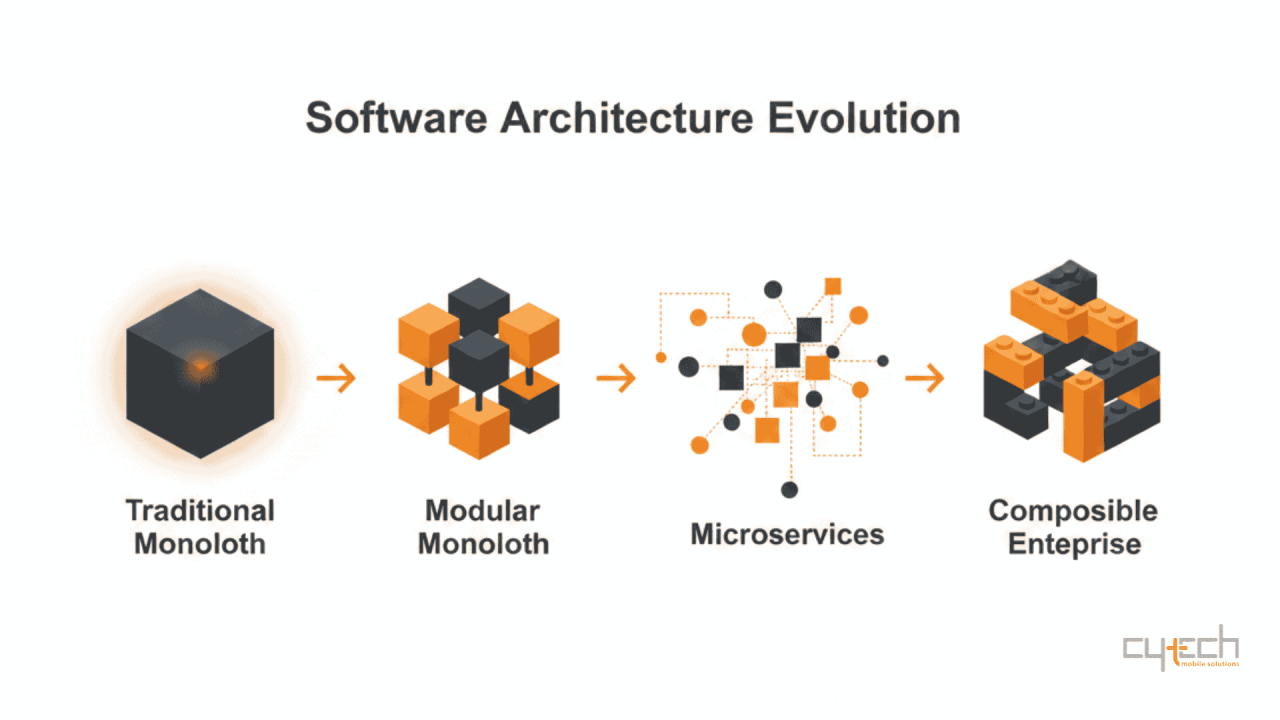
The Traditional Monolith and the Weight of Technical Debt
A monolithic architecture builds an entire application as a single, unified unit where the frontend, backend logic, and database are tightly coupled. While this simplicity allows for rapid initial development and easy debugging, it often leads to a “spaghetti” codebase where changes in one area risk cascading failures elsewhere (source).
The primary danger of a mature monolith is the accumulation of technical debt. When components are interwoven, the “blast radius” of every release increases, requiring the entire system to be redeployed for even minor updates, which effectively slows the pace of innovation to a crawl.
The Modular Monolith: A Strategic Middle Ground
For organizations that require scalability without the operational overhead of microservices, the modular monolith offers a pragmatic solution. This architecture structures the application into loosely coupled, domain-driven modules within a single codebase.
By enforcing strict boundaries through public APIs, developers can reason about individual components in isolation. This approach reduces the cognitive load on engineering teams, as they can focus on specific business functionalities, such as billing or inventory, without needing to grasp a massive, unified system. A well-designed modular monolith is also “distribution-ready,” providing a clear path to microservices if independent scaling becomes necessary.
Architectural Patterns Comparison
| Attribute | Traditional Monolith | Modular Monolith | Microservices |
|---|---|---|---|
| Code Structure | “Big Ball of Mud”; overlapping logic. | Clear logical boundaries (folders/modules). | Physically separated repositories. |
| Deployment | All-or-nothing: One change requires full redeploy. | All-or-nothing: But with safer, isolated builds. | Independent: Deploy one service without touching others. |
| Scalability | Scale the whole app (Vertical). | Scale the whole app (Vertical). | Granular: Scale only the bottleneck service (Horizontal). |
| Data Stores | Single shared database. | Usually one DB, but strictly separated schemas. | Database-per-service: Polyglot persistence. |
| Complexity | Low (at the start). | Moderate (requires discipline). | High: Operational & network overhead. |
| Fault Tolerance | Single point of failure. | Single point of failure. | High: One service failing doesn’t kill the system. |
| Testing | Easy (End-to-End). | Moderate (Integration focus). | Difficult (Requires mocks/contract testing). |
Core Principles of Modular Engineering
The transition to modularity is underpinned by Software Craftsmanship, the philosophy that development is a creative craft focused on building elegant, resilient solutions.
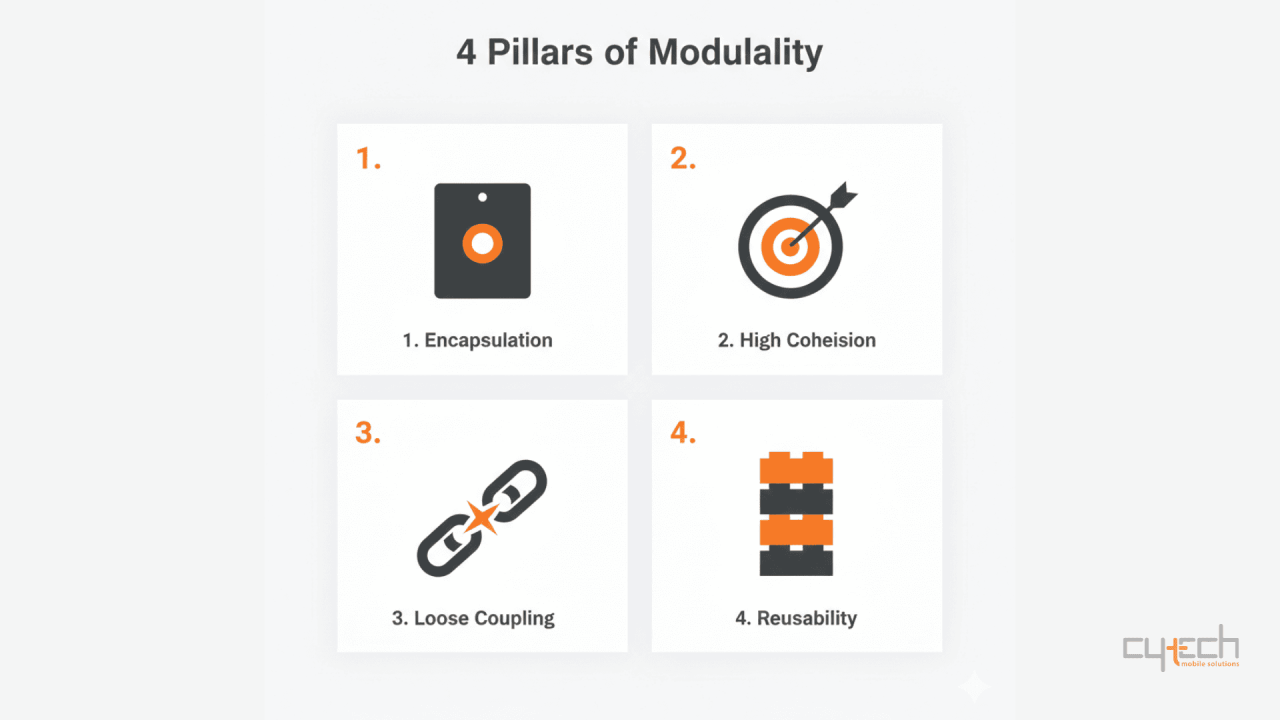
Encapsulation and the “Black Box” Philosophy
A foundational principle of modularity is encapsulation, which requires each module to operate like a “black box”. Internal logic and data access patterns are hidden, with interactions occurring only through well-defined public interfaces. This aligns with the Single Responsibility Principle: a module should have one, and only one, reason to change.
High Cohesion and Low Coupling
The health of a modular codebase is measured by cohesion (how well functionality inside a module belongs together) and coupling (the level of interdependency between modules). Effective modularity aims for high cohesion and low coupling, ensuring that modules remain independent and interchangeable. This independence allows for parallel development, enabling separate teams to work on different features simultaneously without merge conflicts.
Component-Driven Development (CDD) in Modern UIs
In frontend engineering, modularity is practiced through Component-Driven Development (CDD). This methodology builds user interfaces from the “bottom up,” starting with individual buttons (atoms) and ending with full pages (source).
Reusable UI Atoms and Design Systems
CDD allows teams to speak a shared visual language through design systems. By utilizing a centralized library of reusable UI components, organizations ensure that visual elements behave identically across platforms . This consistency not only improves brand trust but also significantly reduces costs; the reuse of pre-tested components can cut development time by up to 60% and costs by as much as 80% (source).
Scaling with Micro-Frontends
Micro-frontends apply the microservices philosophy to the frontend, breaking large monolithic UIs into smaller, independently deployable artifacts. This provides the ultimate level of team autonomy, allowing different teams to use different technology stacks (polyglot frontends) where appropriate.
Mobile Modularization: Performance and Velocity
Modularizing mobile apps presents unique constraints, particularly regarding build velocity and app launch performance (source).
iOS: Projects often transition to modular structures using Swift Package Manager (SPM) . Developers must choose between static and dynamic linking; while dynamic frameworks allow shared instances, they can impose a penalty on app launch time during startup.
Android: Modularization is achieved through Gradle-based modules. Advanced teams leverage Dynamic Feature Modules, allowing users to download specific parts of an app only when needed. This is critical for retention, as data suggests that for every 6MB added to an APK, new installs decrease by approximately 1.6%.
Security and Identity in Decoupled Environments
As applications become modular, the security model must evolve toward a Zero-Trust architecture. Every access request must be verified, regardless of its origin.
Mobile Identity and Authentication
Best practices for 2026 emphasize layering security through Multi-Factor Authentication (MFA) and biometrics. A critical “golden rule” for developers is to store biometric data locally in a device’s secure enclave (KeyStore or Keychain) and never transmit raw biological data to a server. Authentication should be “risk-based,” triggering extra verification only for high-stakes actions like password changes or large payments.
Security and Identity in Decoupled Environments
As applications become modular, the security model must evolve toward a Zero-Trust architecture. Every access request must be verified, regardless of its origin.
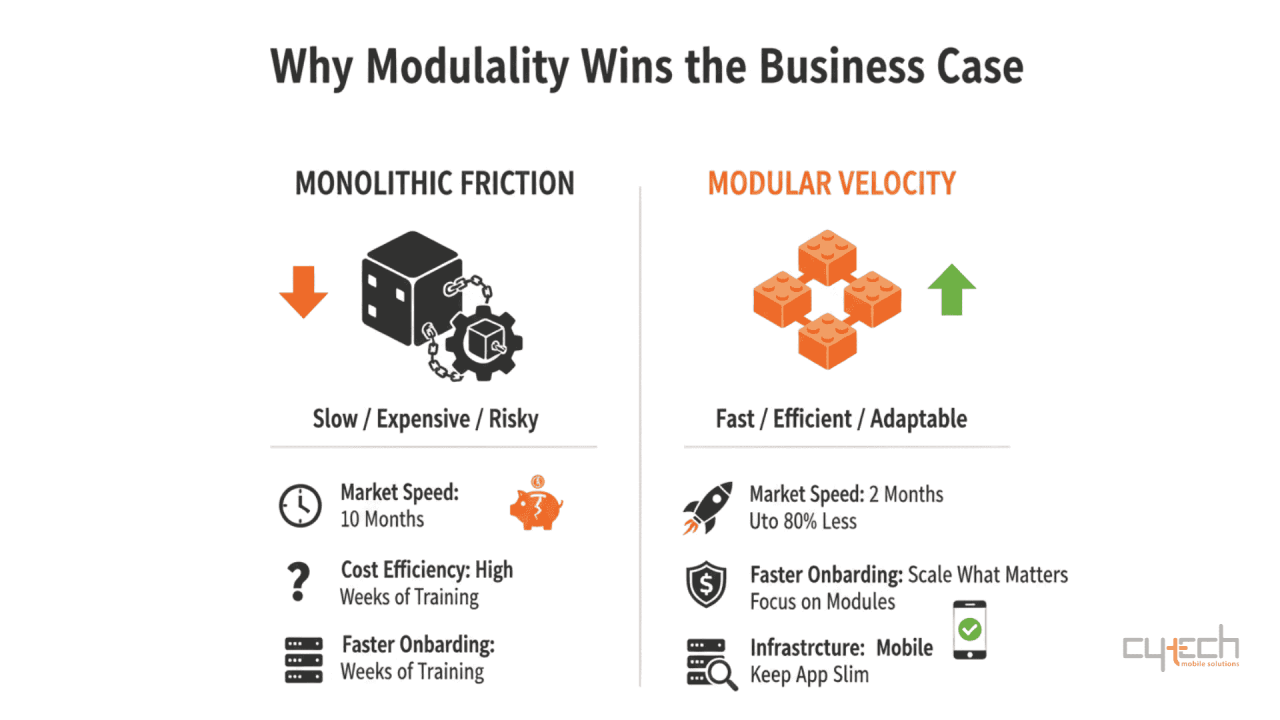
Reduced Cost of Change: In a modular codebase, engineers focus changes on specific modules without wading through the whole system.
Scalability and Infrastructure Optimization: Modular systems are highly cost-effective for cloud deployments. Organizations can spin up additional virtual instances only for high-demand functions—like a login service—rather than replicating an entire resource-heavy application.
Faster Onboarding: Since modules are small and “fit in your head,” new developers can become productive much faster.
Real-World Case Studies
- Shopify: Their core application grew to 2.8 million lines of code, becoming unmaintainable as a simple monolith (source). By moving to a “Modular Monolith” and using their in-house tool Wedge to track domain boundaries, they regained the ability to swap legacy engines for new systems with minimal friction.
- Airbnb: Airbnb leveraged modularity through a robust design system and reusable UI tokens. This allowed them to scale to over 7 million listings globally while maintaining a unified brand identity across iOS, Android, and web versions (source).
The Future: AI-Driven Autonomous Composability
Looking ahead, modularity is being transformed by AI and autonomous infrastructure . We are entering an era of Composable Enterprises, where software is built from Packaged Business Capabilities (PBCs) that can be rapidly reconfigured like Lego blocks.
AI now acts as the “connective tissue” of the enterprise stack, orchestrating modular pieces based on real-time business context . Organizations adopting this approach are projected to outpace their competition by up to 80% in the speed of new feature implementation.
Conclusion
Modular architecture is more than a technical implementation; it is an investment in an organization’s longevity. By embracing these principles, Cytech continues to transform software from a rigid liability into a flexible, strategic advantage. Whether it is through CDD, modular monoliths, or AI-driven orchestration, the future of the digital economy belongs to those who build with modularity at their core.