

Table of Contents
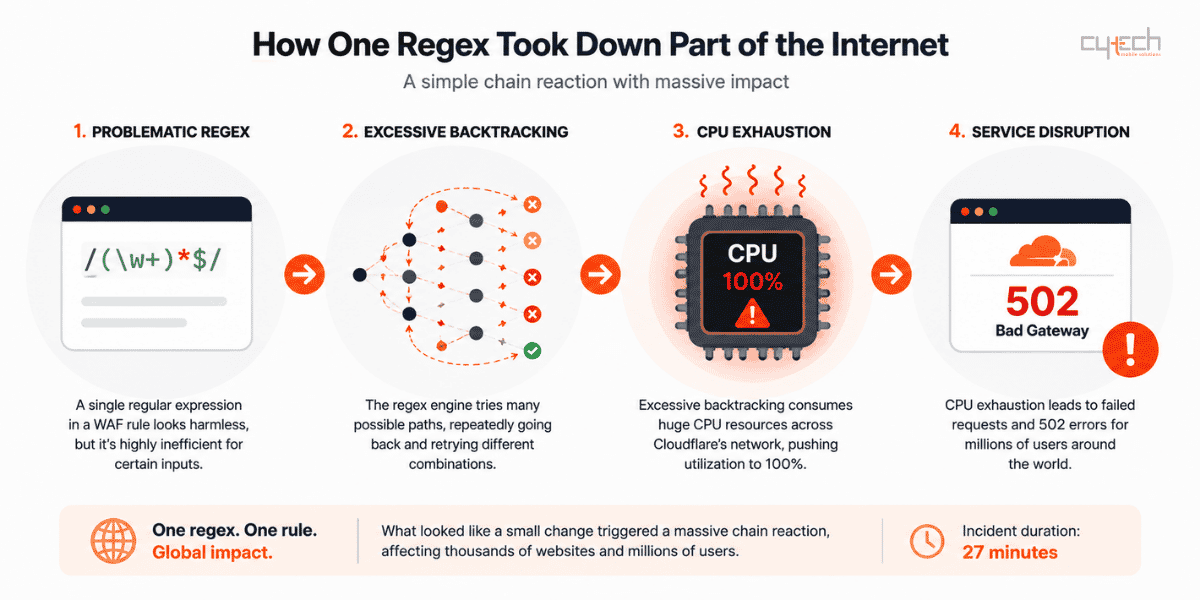
On July 2, 2019, Cloudflare deployed a new rule to its Web Application Firewall, a system designed to help protect websites from malicious traffic. The rule contained a problematic regular expression, or regex, which is a pattern used by software to identify specific sequences of text. Shortly after deployment, CPU utilisation across Cloudflare’s network began rising rapidly toward 100%, causing widespread 502 errors for websites and online services that depended on its infrastructure. The disruption lasted approximately 27 minutes, turning a very small piece of code into a global software incident.
What Went Wrong?
Regular expressions are widely used in software to search text, validate inputs, detect patterns and filter information. In this case, however, the expression triggered excessive backtracking, meaning the system repeatedly explored different possible ways to match the same input. This dramatically increased the amount of processing required. What appeared to be a relatively simple software rule consumed enough computing resources to overload CPUs across Cloudflare’s network. The chain reaction was straightforward: one problematic regex caused excessive backtracking, excessive backtracking caused CPU exhaustion, and CPU exhaustion resulted in a large-scale service disruption.
The Most Interesting Part Wasn’t the Regex
It is easy to look at an incident like this and conclude that a single coding mistake caused the outage. The more important story, however, is what happened around that mistake. Large software systems usually rely on multiple safeguards, including testing, code review, deployment procedures, monitoring and rollback mechanisms. Cloudflare’s own postmortem examined not only the regex itself but also the processes that allowed the change to reach production and affect such a large part of the network. The regex may have triggered the incident, but the scale of the impact depended on the wider system in which that code was deployed.
When Small Weaknesses Combine
Major software failures rarely begin with one spectacular technical mistake. More often, several smaller weaknesses happen to align at the same moment. A test may fail to cover a particular scenario, a deployment may reach too many systems at once, monitoring may detect the problem too slowly, or rollback procedures may not respond as quickly as expected. Individually, each weakness may appear manageable. Together, however, they can transform a minor software issue into an incident affecting thousands or even millions of users.
Designing for Failure, Not Perfection
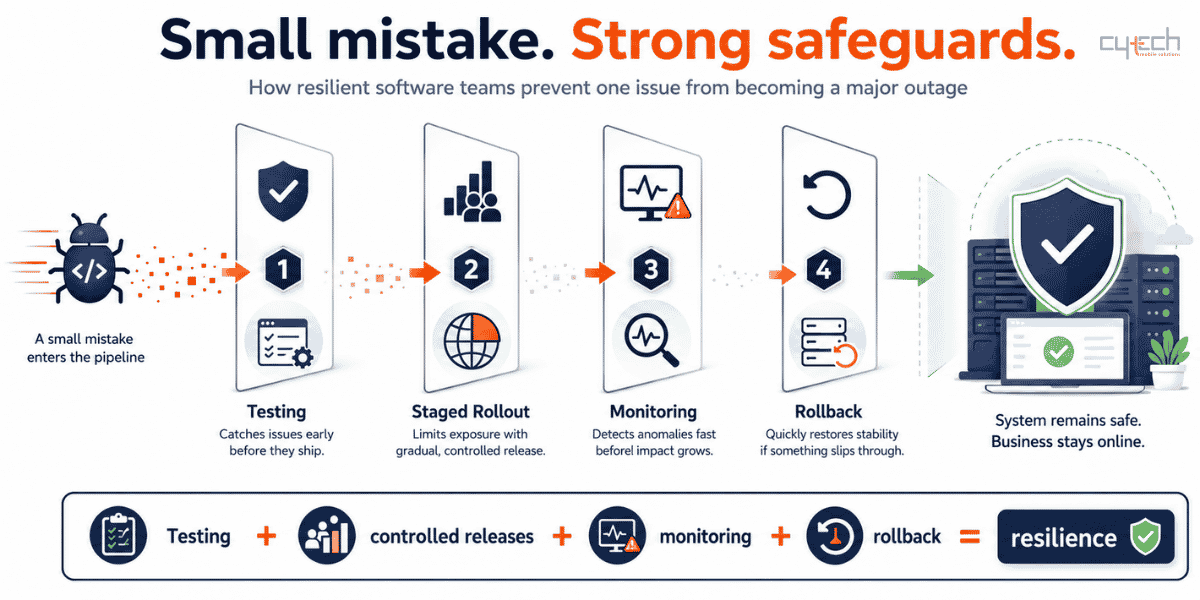
The lesson is not that developers should somehow eliminate every possible bug. In complex software systems, that is unrealistic. A stronger engineering approach assumes that unexpected behaviour will eventually occur and focuses instead on limiting its impact. Good software teams therefore think beyond the question of whether code works under normal conditions. They also consider what happens when it behaves unexpectedly, how quickly the problem can be detected, whether a deployment can be released gradually, and how easily a change can be reversed.
Why Deployment Strategy Matters
Practices such as automated testing, canary releases, progressive rollouts, observability and rapid rollback exist precisely because even small changes can produce unexpected consequences. A staged deployment, for example, can expose a new change to only a small percentage of traffic before it reaches the entire infrastructure. Strong monitoring can reveal unusual CPU usage within seconds, while effective rollback procedures can restore the previous version quickly. These mechanisms create a layer of protection between a software error and a business-critical outage.
The Summer Lesson
Summer may feel like a slower period in many industries, but software systems rarely stop working. Booking platforms continue processing reservations, payment systems continue handling transactions, APIs keep exchanging data and digital services remain available around the clock. This makes reliability especially important during periods when teams may be smaller, customer activity may suddenly increase, or operational patterns may change. The Cloudflare incident is a reminder that even a small technical change can have a large impact when software operates at global scale.
The Bigger Software Lesson
The most valuable lesson from the incident is not simply that regular expressions can be dangerous. It is that resilient software depends on the safeguards surrounding every change. Major failures often emerge when several small protections fail at the same time, allowing a simple technical problem to spread much further than expected. Great software engineering is therefore not about expecting perfection from every line of code. It is about building systems that can detect mistakes quickly, contain their impact and recover before a small problem becomes a major one.