

Table of Contents
At the center of this transformation lies AI-driven routing—a capability that is rapidly becoming the defining competitive edge for telecom platforms and enterprises alike.
A Market Growing—But Under Pressure
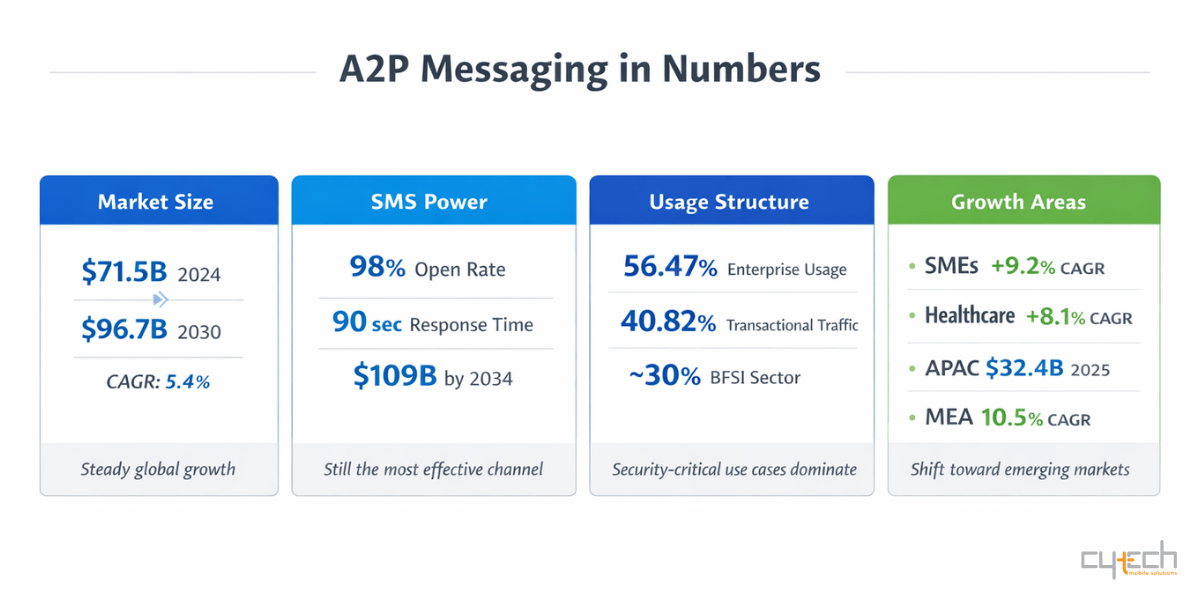
The global A2P messaging market continues to expand, reaching approximately USD 71.50 billion in 2024 and projected to grow to USD 96.73 billion by 2030, driven by a steady CAGR of 5.4%. This growth is supported by the increasing penetration of mobile devices, with 7.3 billion active smartphones expected by 2025.
SMS remains a cornerstone of this ecosystem. Despite the rise of alternative channels, it is forecast to reach USD 109 billion by 2034, thanks to its 98% open rate and average response time of just 90 seconds.
However, the structure of demand is shifting. Large enterprises account for 56.47% of usage, while transactional messaging represents 40.82% of total traffic, heavily driven by OTPs and service alerts. The BFSI sector alone holds nearly 30% of the market, highlighting the importance of secure, reliable delivery.
At the same time, growth is accelerating in new areas. SMEs are expected to expand at a 9.20% CAGR, while healthcare applications grow at 8.10% annually. Regionally, Asia-Pacific leads with USD 32.4 billion by 2025, while the Middle East and Africa are the fastest-growing markets at 10.50% CAGR.
Cloud-based CPaaS platforms are enabling this expansion, already accounting for 58.89% of deployments and expected to reach 65%, offering scalability and seamless integration. Yet beneath this growth lies a critical challenge: trust is eroding.
Fraud and Inefficiency at Scale
The rise of Artificial Inflation of Traffic (AIT)—or SMS pumping—has become one of the most pressing issues in A2P messaging.
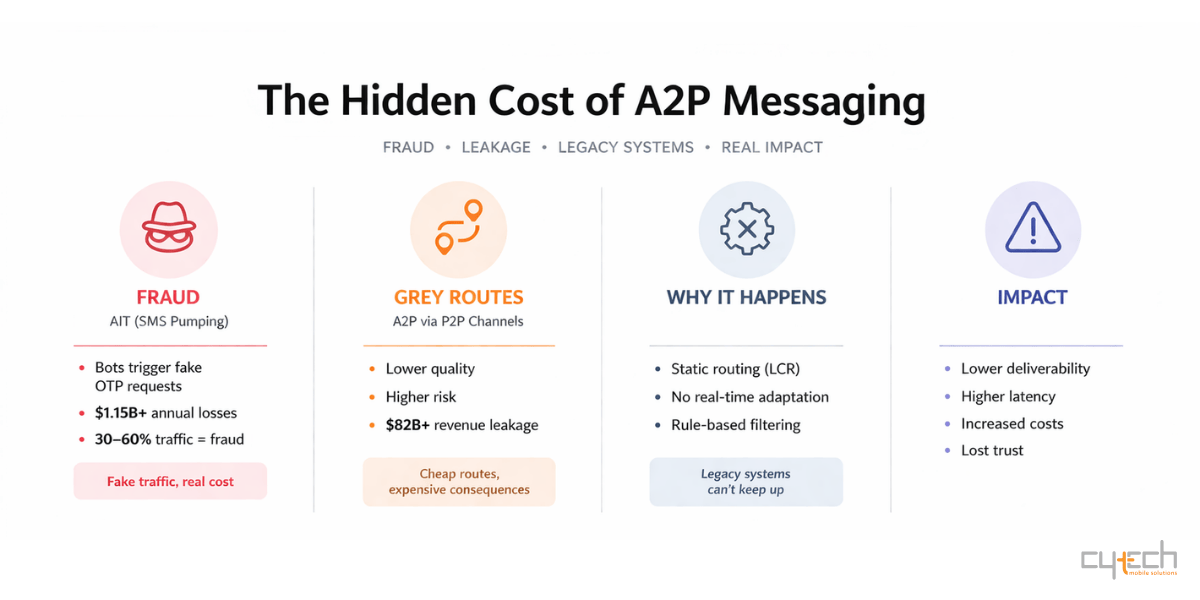
In these attacks, bots generate massive volumes of fake OTP requests, triggering real SMS messages that incur costs but deliver no value. The financial impact is significant, with losses exceeding USD 1.15 billion annually, while in some cases 30% to 60% of total traffic is fraudulent.
At the same time, grey routing continues to undermine the ecosystem by bypassing official A2P channels. While this reduces costs in the short term, it leads to poor quality, higher latency, and major revenue leakage—estimated at up to USD 82.14 billion globally.
These challenges expose the limitations of traditional routing approaches.
Why Traditional Routing Falls Short
Legacy models such as Least Cost Routing (LCR) were designed for a stable environment. They rely on predefined rules and historical assumptions, selecting routes primarily based on cost.
In today’s dynamic environment, this approach is no longer viable.
Network conditions fluctuate constantly, fraud patterns evolve rapidly, and carrier filtering becomes increasingly sophisticated. Static routing cannot respond in real time, leading to reduced deliverability, increased latency, and higher operational risk.
This is where AI-driven routing introduces a fundamental shift.
From Static Routing to Intelligent Decision-Making
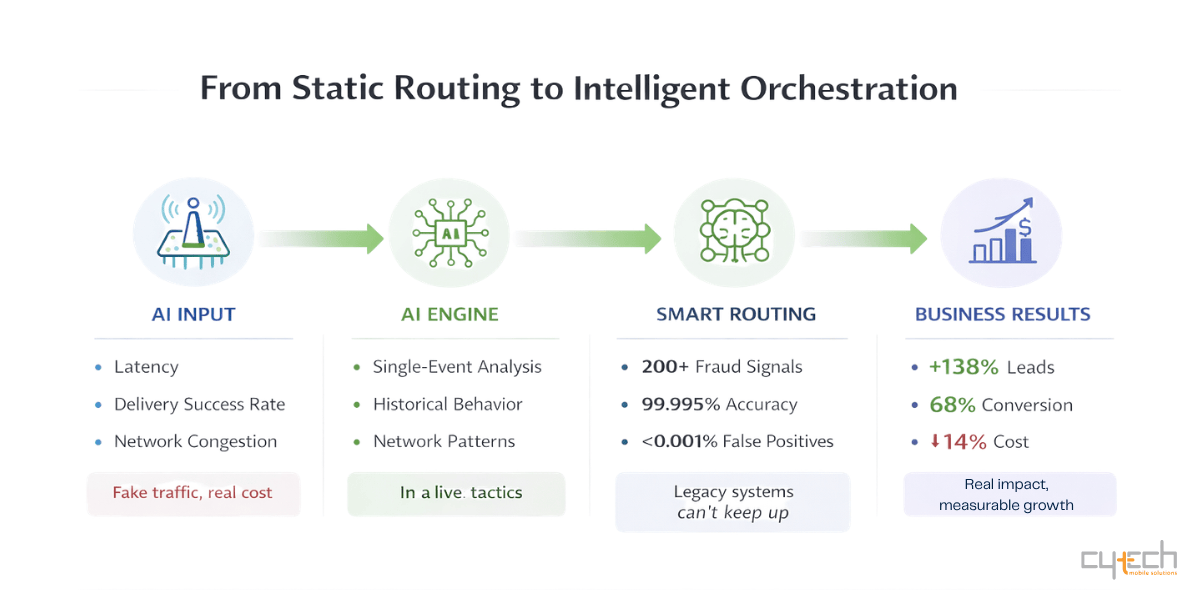
AI-driven routing replaces fixed logic with real-time, data-driven decision-making. Instead of selecting routes based solely on price, it evaluates multiple variables simultaneously, including latency, delivery success rates, network congestion, and carrier performance.
Each message is routed dynamically, based on current conditions rather than predefined assumptions.
The system operates across multiple layers of analysis. It evaluates individual events for anomalies, monitors historical behavior to identify suspicious patterns, and analyzes broader network trends to detect coordinated fraud campaigns. This multi-layered approach enables both performance optimization and proactive fraud detection.
AI as a Fraud Shield
One of the most critical advantages of AI-driven routing is its ability to prevent fraud in real time.
Modern systems analyze hundreds of parameters per message, building behavioral profiles that distinguish legitimate traffic from malicious activity. This allows them to detect attacks even when fraudsters use valid phone numbers—a tactic present in 75% of fraudulent cases.
The effectiveness of these systems is remarkable, achieving 99.995% detection accuracy with false positive rates below 0.001%. In practice, AI-driven fraud protection has already saved enterprises over USD 40.2 million in a single year.
This represents a shift from reactive defense to proactive prevention.
| Capability | Traditional Routing (LCR) | AI-Driven Routing | Business Impact |
|---|---|---|---|
| Decision Logic | Static, rule-based | Real-time, data-driven | Higher efficiency |
| Adaptability | Limited | Continuous learning | Better performance |
| Fraud Detection | Threshold-based | Behavioral AI (200+ signals) | Reduced losses |
| Failover | Manual or delayed | Instant, automated | Higher reliability |
| Cost Optimization | Price-focused | Cost + quality balance | Improved ROI |
| Deliverability | Variable | Optimized in real time | Higher success rates |
Beyond Routing: Intelligent Orchestration
AI-driven routing is also reshaping the role of CPaaS platforms.
The industry is moving from simple API-based communication toward AI orchestration, where systems manage communication flows autonomously. This includes selecting the optimal channel—SMS, WhatsApp, or RCS—based on user context and behavior.
This evolution introduces the concept of Agentic AI, where systems can execute entire workflows, from user interaction to backend processing, without human intervention. The result is a more efficient, responsive, and scalable communication ecosystem.
Business Impact and Revenue Potential
The shift toward intelligent routing is not just about efficiency—it is unlocking new revenue opportunities.
The conversational AI market is projected to reach USD 32.6 billion by 2030, reflecting the growing importance of real-time, personalized communication. Companies leveraging AI-driven messaging are achieving significant results, including conversion rates up to 68%, lead increases of 138%, and cost reductions of around 14%. These outcomes are directly linked to deliverability. Even with a 98% open rate, the value of SMS depends on timely and reliable delivery—something only AI-driven routing can consistently ensure.
The Future of A2P Messaging
Looking ahead, the next phase of A2P messaging will be shaped by 5G, RCS, and AI orchestration.
5G will enable ultra-low latency and massive device connectivity, expanding messaging into IoT and real-time applications. RCS will introduce richer, more interactive experiences, while AI will determine the optimal channel and routing path for every interaction.
In this environment, routing becomes a strategic capability rather than a background function.
Conclusion
The A2P messaging ecosystem is entering a new era.
Cost and volume are no longer enough. Success now depends on intelligence—the ability to adapt, optimize, and protect in real time.
AI-driven routing is at the core of this shift. It transforms messaging from a simple delivery mechanism into a high-performance, secure, and revenue-generating communication layer.
The future belongs to those who move beyond static routing and embrace intelligent orchestration.
Because in modern messaging, the advantage is no longer in sending more messages—but in sending them smarter.
Bibliography
- A2P SMS Market – Size, Trends, Growth and Opportunities (source)
- The Insider One secret to unleashing AI-powered SMS marketing magic (source)
- A2P Messaging Statistics By Usage, Market Size and Facts (2025) (source)
- CPaaS Market Value in North America to Reach $15 Billion by 2026 (source)
- The SMS Pricing Paradox: Why the A2P Messaging Market Needs a New Economic Model (source)
- A2P & Business Messaging Market: 2025-2030 (source)
- CPaaS (Communications Platform as a Service): Architecture, APIs, Benefits & 2026 Industry Guide (source)
- The future of A2P messaging: Challenges and solutions (source)
- Preventing Artificially Inflated SMS Attacks through Large-Scale Traffic Inspection (source)
- Enterprises No Longer Need to Wait for Telecom to Solve SMS AIT (source)
- AIT Prevention: Detect and Block Artificial SMS Traffic with AI Shield (source)
- Artificially inflated traffic (AIT): Causes and solutions (source)
- preventing grey routes and the multi-billion dollar threat (source)
- Understanding A2P Bypass Fraud: How It Erodes Telecom Revenues and What You Can Do About It (source)
- AI-Powered SMS Fraud Prevention: An $80B Threat to Telecom Operators (source)
- Beyond Automation: How AI Is Teaching CPaaS to Understand, Not Just Deliver. (source)
- Enhanced Routing Algorithm Based on Reinforcement Machine Learning—A Case of VoIP Service (source)
- Reinforcement learning based route optimization model to enhance energy efficiency in internet of vehicles (source)
- Leveraging AI for Advanced Anomaly Detection in Telecommunications Networks (source)
- The state of SMS pumping fraud (source)
- Emerging CPaaS Trends Shaping Business Communication (source)
- Understanding Carrier Patterns for A2P SMS (source)