


Table of Contents
We call these small, hidden gems “Easter Eggs.” Yet their origin—and the very idea behind them—didn’t come from a corporate brainstorming session or a clever marketing campaign. It began with something far more genuine: a quiet act of defiance worth just $495, a hidden room, and a developer who refused to remain invisible.
The Era of the “Invisible” Developer
To truly understand this “rebellion,” we need to go back to 1979. The video game industry was still in its infancy, and Atari stood as the undisputed leader. Its business model was straightforward: sell consoles and cartridges. However, its management philosophy was far more rigid—almost inflexible, one might say.
Despite the fact that developers were creating entire worlds within just a few kilobytes of memory, Atari refused to acknowledge their work. There were no names on the packaging. No credits at the end of games. The creators remained, for all intents and purposes, invisible.
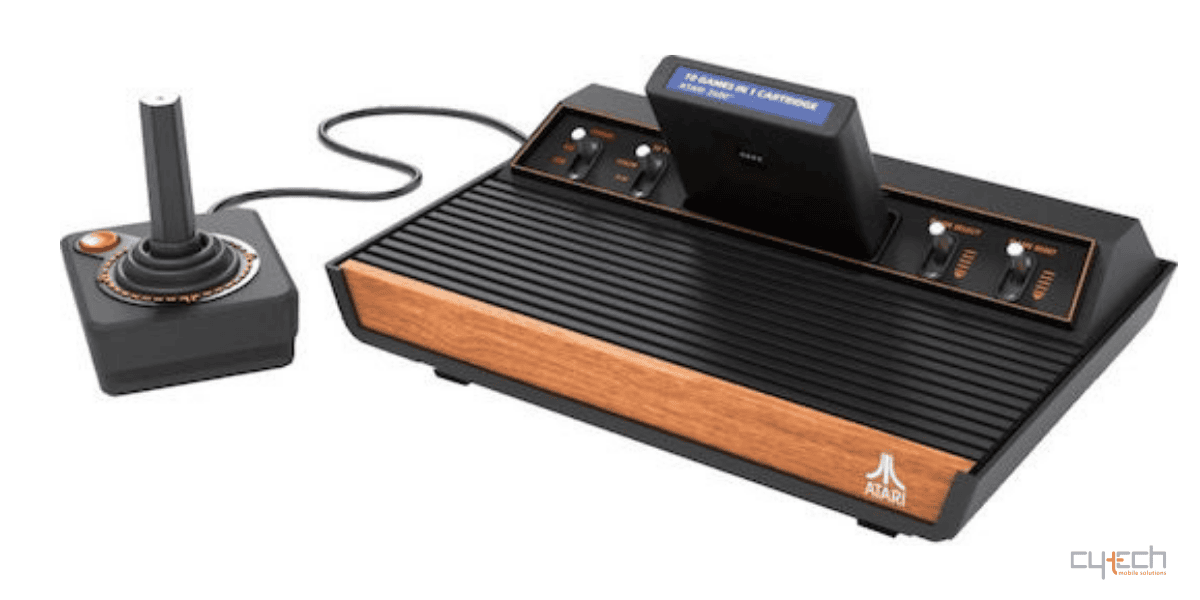
The company’s leadership—particularly CEO Raymond Kassar—treated programmers as interchangeable parts, no different from workers on an assembly line putting together plastic console shells.
The reasoning was simple: if developers became recognized “stars,” they would gain bargaining power—demanding higher salaries or, worse, being poached by competitors.
For those actually writing the code, like Warren Robinett, this wasn’t just unfair—it was a direct insult to their craft.
The “Invisible Pixel” of Adventure
Warren Robinett was working on Adventure, a title now considered revolutionary for its time, as it essentially established the action-adventure genre on consoles. It introduced concepts like “fog of war,” as well as persistent objects—items that remained exactly where you left them—something entirely new back then.

Knowing he would receive no public recognition for his work, Robinett decided to take matters into his own hands. He didn’t ask for permission, didn’t inform anyone… he simply did it.
He dedicated roughly 5% of the game’s total memory—a massive portion for the time, especially considering cartridges only had 4KB of space—to create a hidden sequence. And it was far from easy to discover.
The player had to:
- reach the “Black Castle,”
- find a nearly invisible, grey one-pixel object known as “The Dot,”
- carry this “invisible” object through a series of obstacles,
- and bring it to a specific wall in the Golden Castle.

If everything was done correctly, the player would pass through the wall and enter a secret chamber. There, at the center of the screen, a message would appear, flashing in cycling colors:
“Created by Warren Robinett.”
It was a quiet, yet unmistakable signature.
Discovery and the Birth of “Easter Eggs”
Warren Robinett completed the game and soon after left Atari to pursue other opportunities. He never told anyone at the company what he had done.
Months passed. Adventure had already been released in hundreds of thousands of copies, selling for around $25–30 each and generating millions in revenue for Atari. Then came the unexpected twist: a 15-year-old boy from Salt Lake City sent a letter to the company. He wasn’t reporting a bug—he was asking about the mysterious “secret room” he had discovered.
Atari’s management was completely caught off guard. According to reports, they even considered recalling the game to remove the hidden code. But the cost would have been enormous—over $10,000 at the time (roughly $45,000 today)—just to “fix” something that wasn’t actually breaking the game.
At that moment, Brad Stewart, Director of Software Development, saw the bigger picture. Instead of treating it as a breach or misconduct, he recognized the brilliance behind it. He convinced management that these hidden features could actually enhance the appeal of their games.
He even compared the search for the secret room to an Easter egg hunt—a playful act of discovery.
And just like that, the term “Easter Egg” was born.
Rather than pushing back, Atari embraced the idea. From that point on, they began encouraging developers to include hidden surprises in their games—transforming a quiet act of defiance into a defining element of gaming culture.
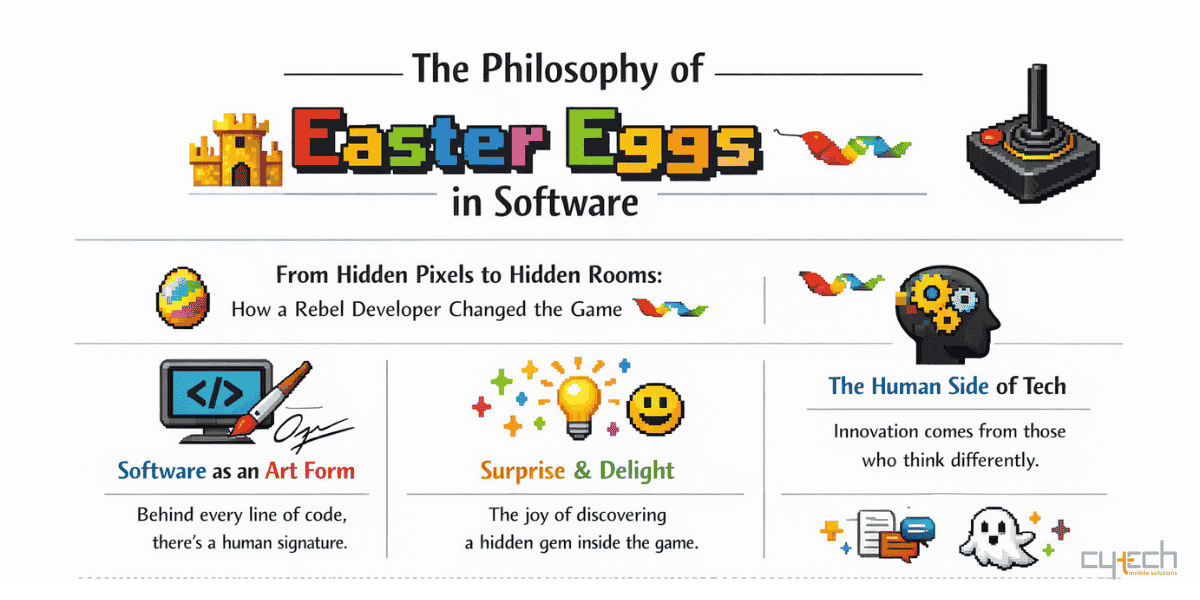
Why the “$495 Rebellion” Still Matters Today
You might be wondering where the $495 comes from. That was roughly Warren Robinett’s monthly salary at the time he was developing Adventure. In other words, for the price of a single paycheck, he managed to secure something far greater—his own form of digital immortality.
But beyond this intriguing detail, the story carries three important lessons for today’s software industry:
1. Software as an Art Form
The “Easter Egg” marked the first time a developer essentially stood up and said: “This isn’t just a product—it’s my work.” It was a powerful reminder to the entire industry that behind every line of code, there is a human being—with a signature.
At Cytech, we believe exactly that: great software isn’t defined only by what it does, but by the craftsmanship behind it.
2. The Power of “Surprise & Delight”
Robinett’s secret room didn’t give players an advantage. It didn’t unlock a new feature or make the game easier.
What it offered was something far more valuable: a moment of discovery—that small “Ah, I found it!” feeling that stays with you.
Today, this element of “surprise & delight” is a core principle of modern UX design. It’s what separates a tool you simply use from a product you genuinely enjoy.
3. The Human Side of Technology
In an era increasingly defined by AI-generated code and automation, the story of the first Easter Eggs serves as a reminder: innovation always has a human origin.
It often comes from those who don’t blindly follow the rules—the curious, restless minds who think differently and dare to create something unexpected.

Conclusion: Keep Hunting
The next time you discover a hidden feature in your favorite app or a quirky message buried in documentation, think of Warren Robinett. Think of “The Dot.” And above all, remember that even within the most rigid corporate environments, there’s always room for a little creative… disobedience.
This Easter, take a closer look at the software you use every day. You never know what “invisible pixels” might be hiding in plain sight.
Happy hunting from the Cytech team!
Bonus Fact: Robinett’s secret room became so iconic that it played a central role in the book and film Ready Player One, where the protagonist must find that very same “invisible pixel” to win a trillion-dollar contest.