


Table of Contents
Today, the most valuable engineers aren’t just masters of syntax or specific frameworks; they are systems thinkers.
Modern engineering organizations increasingly recognize that the highest-performing teams are those that look beyond the immediate line of code to understand the interconnected web of dependencies, business logic, and human factors that surround it. This is the foundation of a coding culture that doesn’t just ship features, but builds resilient, scalable ecosystems.
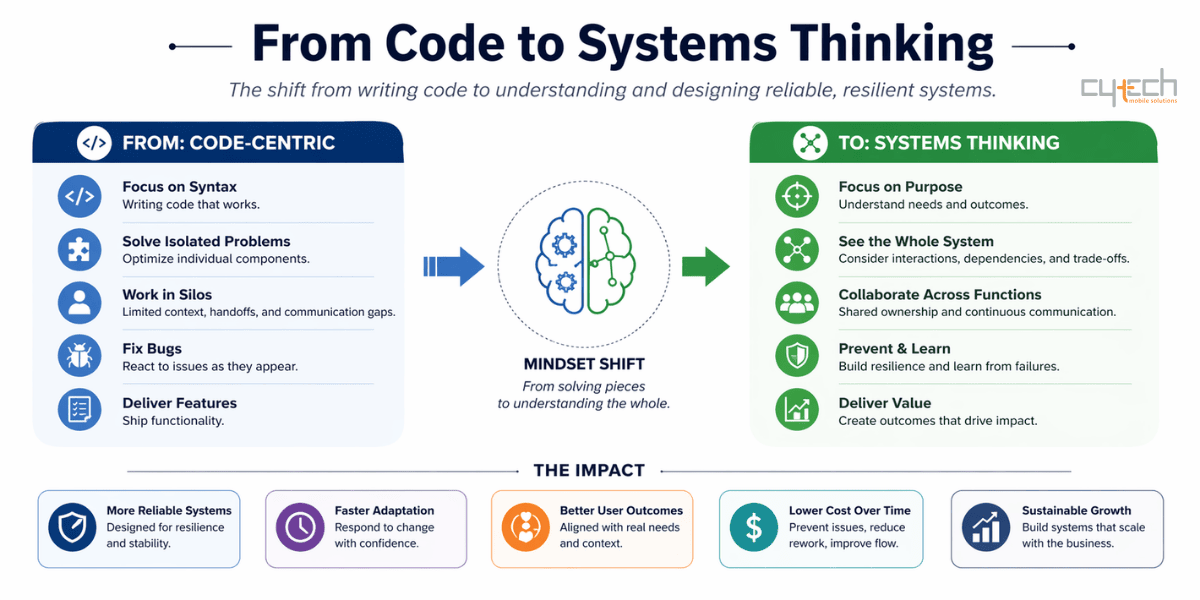
Linear vs. Systems Engineering: A Comparison
To understand this cultural shift, it helps to look at how different mindsets approach common engineering challenges.
| Feature | Linear Engineering (Traditional) | Systems Engineering (Modern) |
|---|---|---|
| Problem Solving | Fixes the immediate bug or ticket. | Addresses the root cause and prevents regression. |
| Code Perspective | “My code works on my machine.” | “How does this code affect the global state?” |
| Focus Area | Component-level optimization. | End-to-end flow and stability. |
| Failure Response | Find who is responsible (Blame). | Improve the safety net (Blameless). |
| Complexity | Adds features/services to solve issues. | Prioritizes simplification and consolidation. |
| Success Metric | Velocity and lines of code produced. | System resilience and mean time to recovery. |
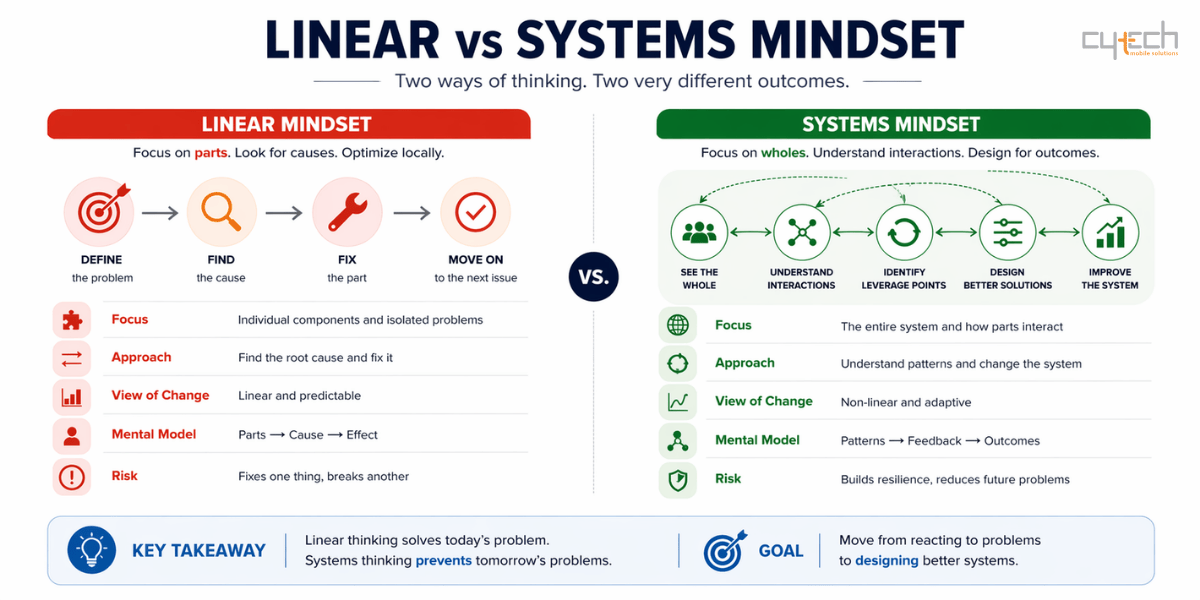
What is Systems Thinking in Engineering?
Systems thinking is the practice of analyzing how parts of a system interact with one another within the context of the whole. In software engineering, it represents a cognitive transition from linear troubleshooting to holistic architectural reasoning. It is the shift from asking “Why is this function failing?” to “How does this data flow impact the downstream cache, the user experience, the cloud infrastructure costs, and the data consistency of our reporting engine?”
A developer who thinks in systems recognizes three core truths that govern modern software:
- The Interconnectedness of Change: A system thinker knows that there is no such thing as a “local” change in a sufficiently complex environment. A minor tweak to a database schema isn’t just a back-end update; it is a potential breaking change for the frontend, a schema-registry conflict for the event bus, and a new data-cleansing requirement for the analytics team.
- The Primacy of Feedback Loops: Systems are defined by how they respond to inputs over time. Understanding how a system responds to sudden spikes in load, network partition, or partial service degradation is as important as the feature logic itself. A systems-oriented developer looks for “vicious cycles”—where a slow database leads to retry storms, which in turn crash the database.
- The Socio-Technical Reality: The “Human System” is inseparable from the “Technical System.” The communication pipelines between teams are just as vital—and often just as prone to failure—as the CI/CD pipelines. Systems thinking requires acknowledging that code architecture often mirrors the organizational chart (Conway’s Law).
The Pillars of a Systems-Oriented Culture
Building this culture is not a one-time workshop; it requires a deliberate, ongoing shift in values, tools, and daily rituals. It is a movement away from localized optimization toward global stability.
1. Visibility Over Silos: The End of “Magic Boxes”
Systems thinking dies in the dark. You cannot reason about a system if you can only see the 5% of it that you personally maintain. In many legacy cultures, developers “throw code over the wall” to QA or DevOps, never seeing how their work behaves in the wild.
To combat this, the industry is moving toward Radical Observability. This isn’t just about collecting logs; it is about democratizing the “map” of the architecture. When a developer can see a real-time trace of a request moving through six different services, they stop thinking about their service as an island.
- The Trend: We see an increasing adoption of distributed tracing (like OpenTelemetry) and real-time service meshes. High-performing teams now encourage “Architectural Guilds” to ensure that no part of the stack is treated as a “black box” by the rest of the organization.
2. Rewarding “Negative Space” Engineering
In traditional frameworks, developers are rewarded for the volume of code they produce. However, a systems thinker knows that every line of code is a liability. “Negative Space” engineering is the art of solving problems by reducing complexity—recognizing that adding a new microservice might solve a temporary problem but will increase the system’s overall entropy.
- The Trend: Shifting KPIs to celebrate refactors that result in fewer dependencies and smaller codebases. There is a growing prestige for the engineer who identifies that a requested feature is already covered by an existing internal API or can be solved by a more efficient architectural pattern.
3. Embracing the “Second-Order Effect” and Blamelessness
When a bug occurs, a linear thinker fixes the bug and moves on. A systems thinker asks: “Why did the system’s architecture allow this bug to exist? What were the second and third-order effects of this failure?” Systems thinking requires looking past the immediate symptom to the underlying structural cause.
- The Trend: The rise of Blameless Post-Mortems. In a systems-thinking culture, the question is never “Who broke the build?” but rather “What gap in our safety nets allowed this change to propagate?” By removing blame, organizations focus on fixing the system rather than punishing the individual.
4. Designing for Failure: The Antifragility Mindset
Systems thinkers embrace the concept of Antifragility—the idea that a system should not just withstand stress but actually improve or fail gracefully under it. They don’t build for perfection; they build for recovery. This involves implementing “circuit breakers,” “graceful degradation,” and “bulkhead patterns.”
The Trend: The mainstreaming of “Chaos Engineering.” Teams are intentionally injecting faults into staging environments to see how the rest of the system reacts. This practice moves the team’s mental model from “Hope it works” to “Know it recovers.”
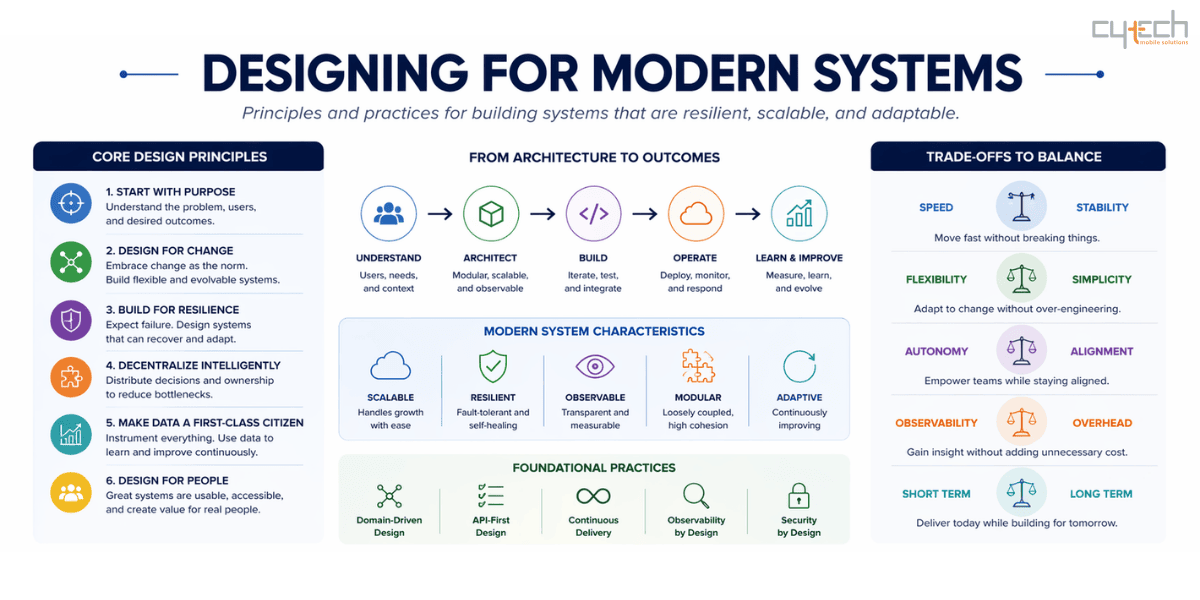
The Socio-Technical Bridge: Conway’s Law in Action
A crucial aspect of systems thinking is the “Human System.” Conway’s Law states that organizations are constrained to produce designs which are copies of their communication structures. If you have siloed teams, you will produce siloed code. Friction between Product and Engineering will inevitably produce friction in the user experience.
Building a systems-thinking culture means designing team boundaries that align with the desired software boundaries. It means encouraging cross-functional “pods” where the person writing the code, the person deploying it, and the person defining the business requirement are in constant, high-bandwidth communication.
How to Lead the Transition
For team leads and CTOs, cultivating this mindset requires a shift in how they lead and who they hire.
Change the Language of Review
Culture is built in the small moments. During code reviews, leaders should shift the linguistic focus:
“Are we introducing a circular dependency here that will block future refactoring?”
“How does this change affect our P99 latency?”
“If this external API goes down, what is the user’s fallback experience?”
Hire for Curiosity and Trade-offs
The industry is moving away from LeetCode-style brain teasers. Instead, the trend is toward open-ended system design problems where there is no “correct” answer—only trade-offs. A systems thinker cares more about the “why” than the “how.”
Bridge the Gap Between Dev and Ops
The DevOps movement was the first great push toward systems thinking. High-performing cultures ensure that “Ops” is a philosophy, not just a department. Every developer should have some exposure to infrastructure-as-code and observability dashboards to understand the reality of the system.
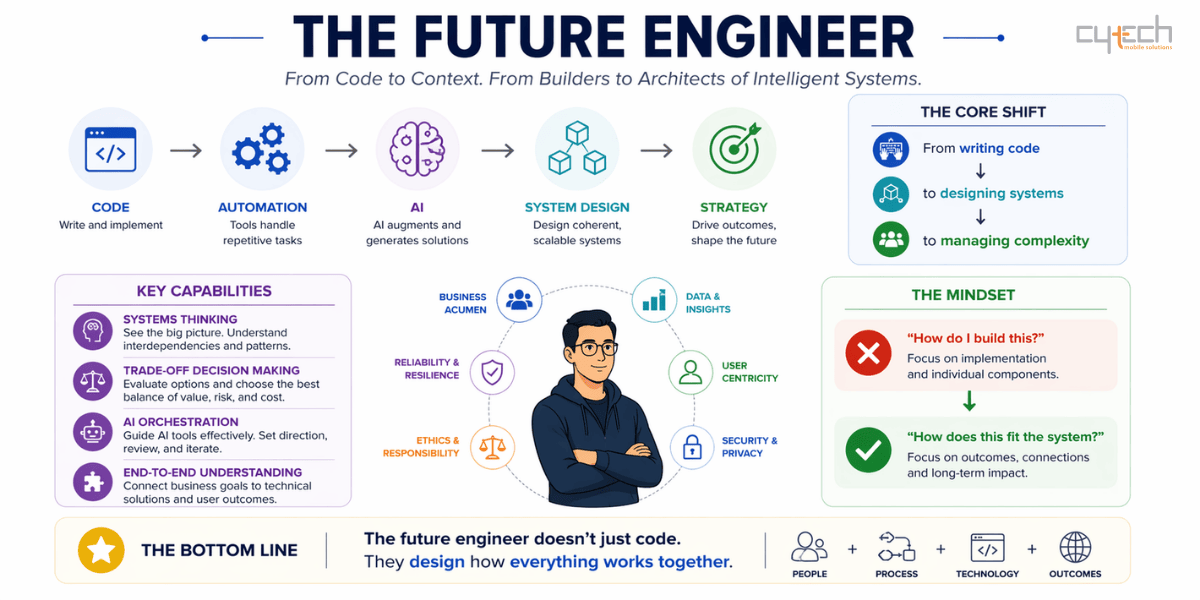
The Competitive Advantage: Why It Matters Now
Why is this shift accelerating? Because in an increasingly complex world, systems-thinking teams build simpler, more profitable software. When engineers understand the whole, they stop over-engineering local parts. They build APIs that are more intuitive because they understand the consumer’s context.
Furthermore, as AI begins to handle more of the boilerplate “coding” tasks, the human engineer’s primary role is shifting upward. The future belongs to the Architect-Engineer: the person who can guide AI to build components that fit into a cohesive, resilient, and ethically sound system. Organizations that master this shift aren’t just shipping code; they are managing complexity.
The question for every engineering leader today is simple: Does your team see the lines between the boxes, or just the boxes themselves?