


Table of Contents
For many years, A2P messaging was viewed primarily as a delivery mechanism. The goal was simple: ensure messages reached users quickly and at the lowest possible cost. Today, that perspective has fundamentally changed. A2P messaging has evolved into a core component of digital business infrastructure. Banks rely on it for authentication, e-commerce platforms for order updates, healthcare providers for appointment management, and logistics, fintech, SaaS, and public-sector organizations for real-time communication.
As a result, expectations have shifted. Enterprises no longer seek basic delivery alone, they demand reliability, transparency, branded communication, intelligent routing, robust reporting, fraud protection, seamless API integration, and scalable infrastructure. At the same time, telecom operators, SMS aggregators, CPaaS providers, and digital service resellers face increasing pressure to expand their messaging capabilities quickly, without absorbing the full cost and complexity of building systems from scratch.
This is precisely where white-label A2P messaging solutions are gaining traction.
A white-label A2P messaging solution enables a company to offer a fully branded messaging platform while relying on underlying technology developed and maintained by a specialized provider. In practice, this allows operators, aggregators, and service providers to deliver SMS and business messaging services under their own identity, without investing years in building routing engines, APIs, billing systems, reporting tools, customer portals, and vendor integrations. Instead, they can focus on growth, partnerships, and customer acquisition.
A Growing Market Creates New Opportunities
The demand for white-label A2P messaging solutions is directly linked to the expansion of the A2P messaging market itself. According to Grand View Research, the market was valued at USD 74.27 billion in 2025 and is expected to reach USD 125.79 billion by 2033, growing at a CAGR of 7.2% (2026–2033). IMARC Group similarly estimates the market at USD 74.8 billion in 2025, projecting it to grow to USD 102.0 billion by 2034, with a CAGR of 3.40% (2026–2034).
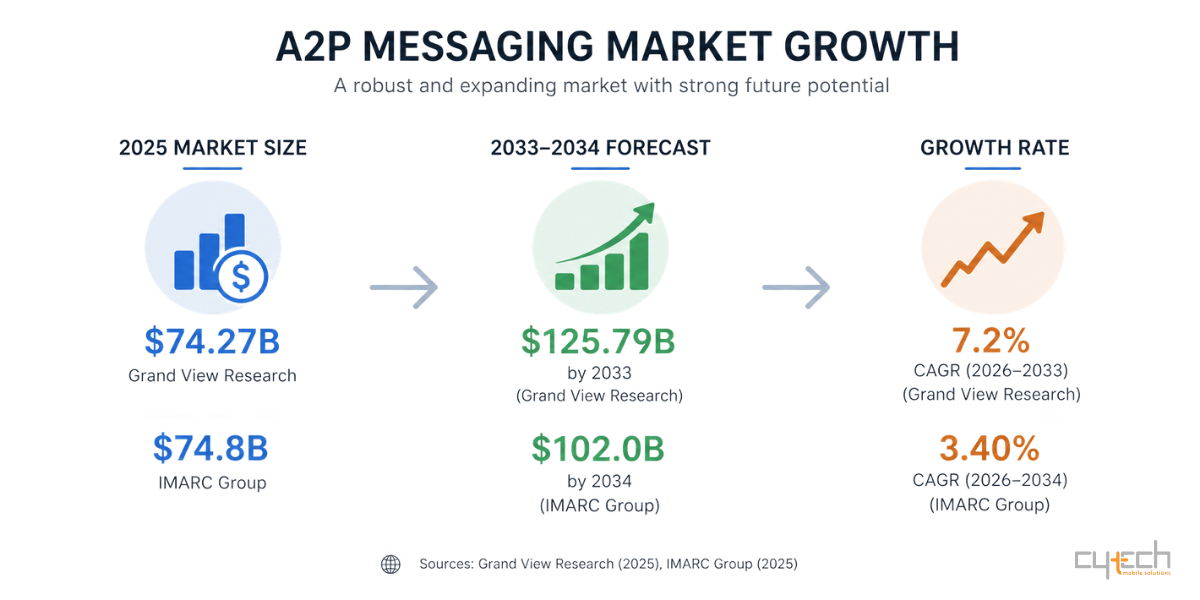
These figures highlight a critical reality: despite the proliferation of digital channels, SMS and mobile messaging remain indispensable. Unlike mobile apps, SMS requires no installation. Unlike email, it is typically read within minutes. And unlike many digital channels, it supports both transactional and promotional communication effectively.
However, as the market grows, so does competition. Providers must go beyond connectivity and offer complete messaging solutions, platforms that enable them to manage customers, traffic, suppliers, pricing, reporting, and performance efficiently. White-label solutions provide exactly this operational backbone.
Why White-Label A2P Messaging Is Gaining Momentum
The primary advantage of white-label A2P messaging is speed. Building a messaging platform from scratch is resource-intensive, requiring telecom expertise, software development, infrastructure management, routing logic, compliance, billing systems, APIs, and ongoing technical support. For most companies, this is neither practical nor efficient.
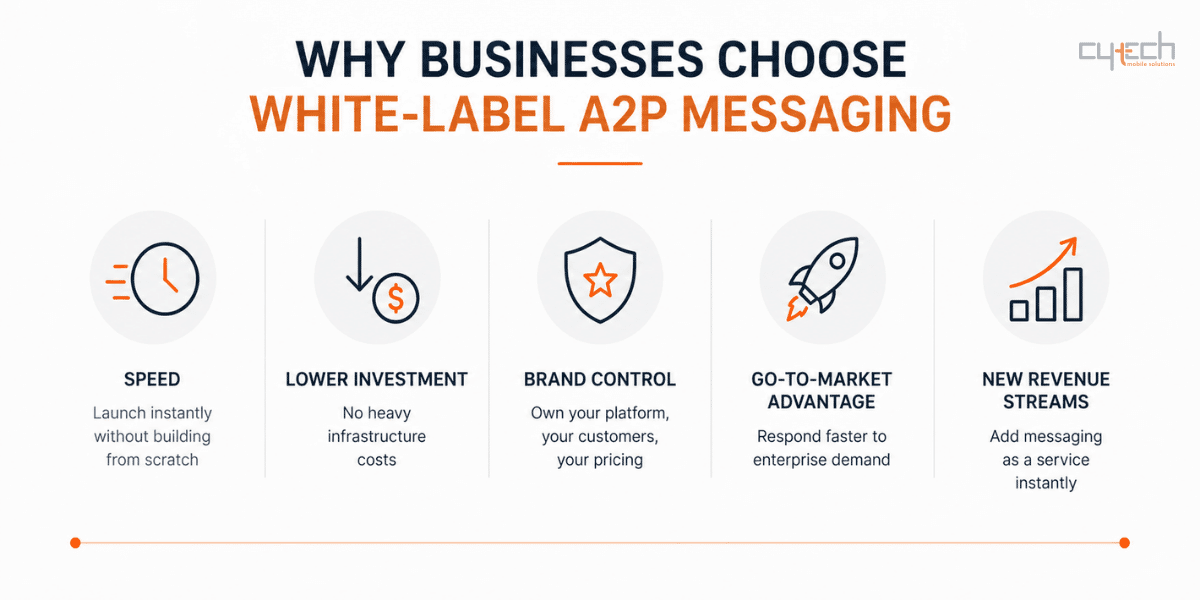
White-label platforms eliminate this barrier. They allow telecom operators to expand their services, aggregators to upgrade their offerings, and resellers or IT providers to introduce messaging as a new revenue stream, all without heavy upfront investment.
This speed is critical in a market where opportunities emerge quickly. A bank may need cross-border OTP delivery, a retailer may require fast campaign deployment, or a logistics company may need automated notifications. Providers equipped with white-label platforms can respond immediately, capturing opportunities that slower competitors miss.
Market Drivers Behind White-Label A2P Messaging Demand
| Market Driver | What It Means for A2P Providers | Why White-Label Solutions Help |
|---|---|---|
| Growing enterprise demand | Businesses rely on A2P messaging for OTPs, alerts, notifications, and engagement. | Faster launch of branded messaging services without full infrastructure development. |
| Need for faster go-to-market | Providers must quickly respond to enterprise needs and market opportunities. | Reduced development time, enabling focus on growth and partnerships. |
| Brand ownership | Providers want to maintain direct relationships with customers under their own brand. | Full control over branding, domain, interface, and pricing models. |
| Route and vendor complexity | Managing multiple suppliers, destinations, and pricing rules is increasingly complex. | Built-in routing, vendor management, reporting, and billing capabilities. |
| Fraud and grey-route pressure | Smishing, grey routes, and artificial traffic inflation create risks. | Enhanced visibility, monitoring, and traffic control. |
| Omnichannel evolution | SMS is expanding into RCS and OTT channels. | Scalable foundation for future messaging channels. |
| Margin protection | Providers must balance cost, performance, and pricing. | Intelligent routing and analytics improve efficiency and profitability. |
Flexibility as a Competitive Advantage
Modern A2P messaging is inherently complex. Providers must handle diverse customer needs, multiple vendors, varying pricing structures, and different service-level requirements. Some clients prioritize cost efficiency, others demand speed, and others require maximum reliability for critical communications such as authentication.
This complexity makes flexibility essential. A robust white-label platform must support API integration, routing logic, delivery tracking, billing systems, vendor management, and real-time analytics. These are not just technical features, they directly influence profitability, service quality, and customer satisfaction.
For example, intelligent routing ensures messages follow the most efficient path based on cost or performance. Delivery reports provide visibility into message success rates. Billing systems enable customized pricing per customer or destination. APIs allow enterprises to integrate messaging directly into their systems.
This transforms messaging from a commodity into a high-value service.
Trust, Fraud Prevention, and Control
The A2P ecosystem is increasingly affected by fraud, grey routing, sender ID misuse, and artificial traffic inflation. These issues lead to financial losses, unreliable delivery, and reputational damage. As messaging becomes central to authentication and security, trust becomes a non-negotiable requirement.
Juniper Research warns that without intervention, A2P SMS revenue across Africa, the Middle East, Asia-Pacific, and Latin America could decline by 23% by 2029. This underscores the urgency of improving transparency and control in messaging operations.
For providers, this presents both risk and opportunity. While expectations are higher, white-label platforms can deliver the tools needed to meet them, offering enhanced monitoring, routing control, and reporting. This enables providers to differentiate through reliability and trust, rather than competing solely on price.
The Shift Toward Omnichannel Messaging
While SMS remains foundational, the messaging landscape is evolving. RCS, WhatsApp, Viber, and other rich communication channels are becoming integral to enterprise communication strategies. According to Infobip (citing Omdia), RCS traffic is expected to grow from 1.5 trillion messages in 2024 to over 6 trillion messages in 2029, with A2P RCS revenues reaching USD 4.2 billion by 2029.
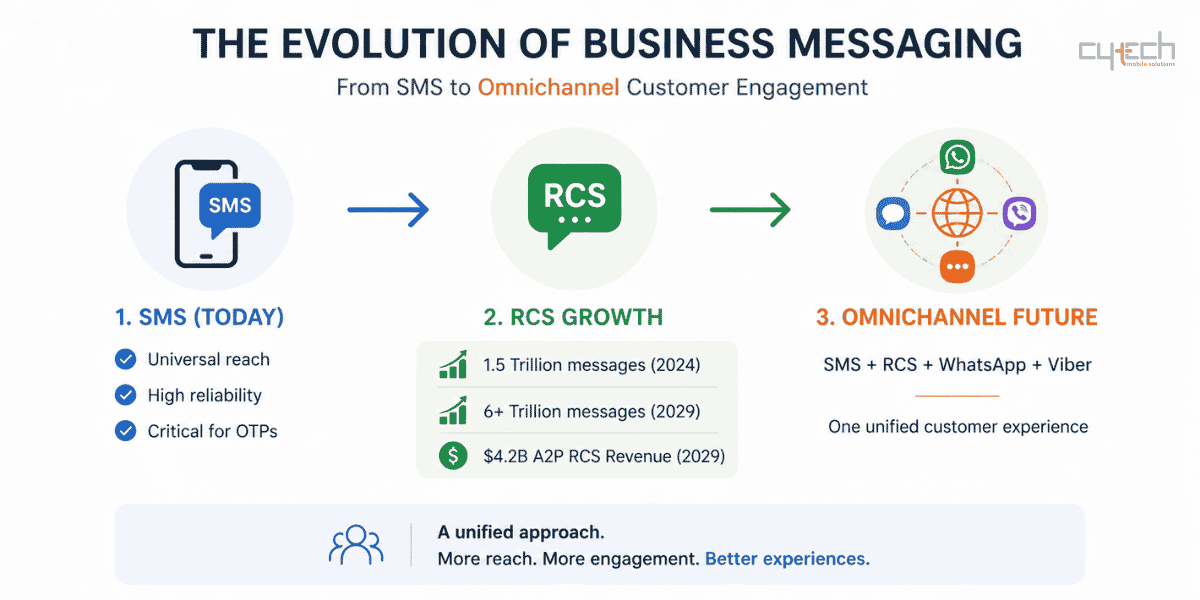
This evolution does not replace SMS, it complements it. SMS remains unmatched in reach and reliability, particularly for critical use cases like OTPs. However, enterprises increasingly adopt multi-channel strategies, combining SMS with richer messaging formats for engagement and customer experience.
White-label platforms that support this transition provide long-term strategic value. They allow providers to start with SMS and expand into omnichannel messaging as market demand evolves.
Cytech’s Perspective: Enabling Branded Messaging Businesses
At Cytech Mobile, A2P messaging is seen not just as a communication channel, but as a critical business infrastructure. Through mCore, Cytech enables telecom operators, aggregators, and service providers to launch and scale messaging services under their own brand, supported by a robust and flexible platform.
A modern white-label A2P platform must empower providers to own their customer relationships, control their commercial strategies, manage traffic efficiently, and adapt to evolving market demands. It must reduce complexity while preserving flexibility and control.
As enterprise demand continues to grow, success will depend on the ability to combine speed, reliability, brand ownership, and operational intelligence. White-label A2P messaging solutions provide exactly this advantage, enabling faster market entry, stronger differentiation, and more sustainable profitability.
The future of A2P messaging will not belong only to those with the largest networks. It will belong to those who can deliver smarter, more reliable, and more adaptable messaging services. White-label platforms are making that future accessible to a wider range of providers than ever before.
Bibliography
- Grand View Research – A2P Messaging Market Report
- IMARC Group – A2P Messaging Market Analysis
- Juniper Research – A2P SMS Trust & Revenue Decline Warning
- Infobip – RCS Messaging Growth (based on Omdia data)
- Twilio – What is A2P Messaging
- Fortune Business Insights – Enterprise A2P SMS Market
- GMS – A2P Messaging Trends 2026 (Mobilesquared insights)
- MEF (Mobile Ecosystem Forum) – Business Messaging Yearbook
- Mobile Ecosystem Forum – RCS vs SMS Whitepaper
- Global Telco Consult – Evolution of A2P Messaging