


Table of Contents
Within most organizations, A2P was positioned as an efficient transport layer. It functioned as a technical pipe that carried messages from enterprise systems to the mobile devices of end users. Performance was assessed almost exclusively through technical indicators such as throughput, route availability, delivery rates, and cost per message.
Today, this model is rapidly losing relevance.
Application-to-Person SMS is entering a new stage of maturity, in which platforms are no longer evaluated by how many messages they can deliver, but by how much business value they can generate on top of that traffic. Increasingly, messaging platforms are evolving from pure delivery mechanisms into monetization layers that embed identity management, trust, regulatory compliance, analytics, and business intelligence.
For service providers and aggregators, this shift goes far beyond a technical upgrade. It represents a fundamental repositioning of Application-to-Person messaging from an operational service to a revenue platform.
The End of the Pipe-Only A2P Model
The traditional A2P business model was simple. Providers sold message volume, optimized routing, and competed primarily on price.
This approach was effective when SMS was the dominant mobile messaging channel and enterprises had few alternatives. However, the rapid growth of OTT messaging platforms fundamentally changed market expectations. Although OTTs did not replace A2P SMS in mission-critical use cases such as one-time passwords, payment notifications, or security alerts, they significantly reshaped perceptions around cost, flexibility, and value.
As a result, the A2P ecosystem has faced sustained pressure on margins. Price competition intensified while operational complexity increased sharply. Fraud, spoofing, fragmented regulatory frameworks, and higher quality expectations became standard challenges, without a proportional increase in revenue per message.
In this environment, treating A2P as a simple transport mechanism became economically unsustainable.
The answer was not to abandon A2P, but to move upward in the value chain.
From Volume to Value: The New A2P Equation
Modern A2P platforms are no longer built around volume alone. They are designed around what enterprises actually value: trust, reliability, regulatory certainty, and visibility.
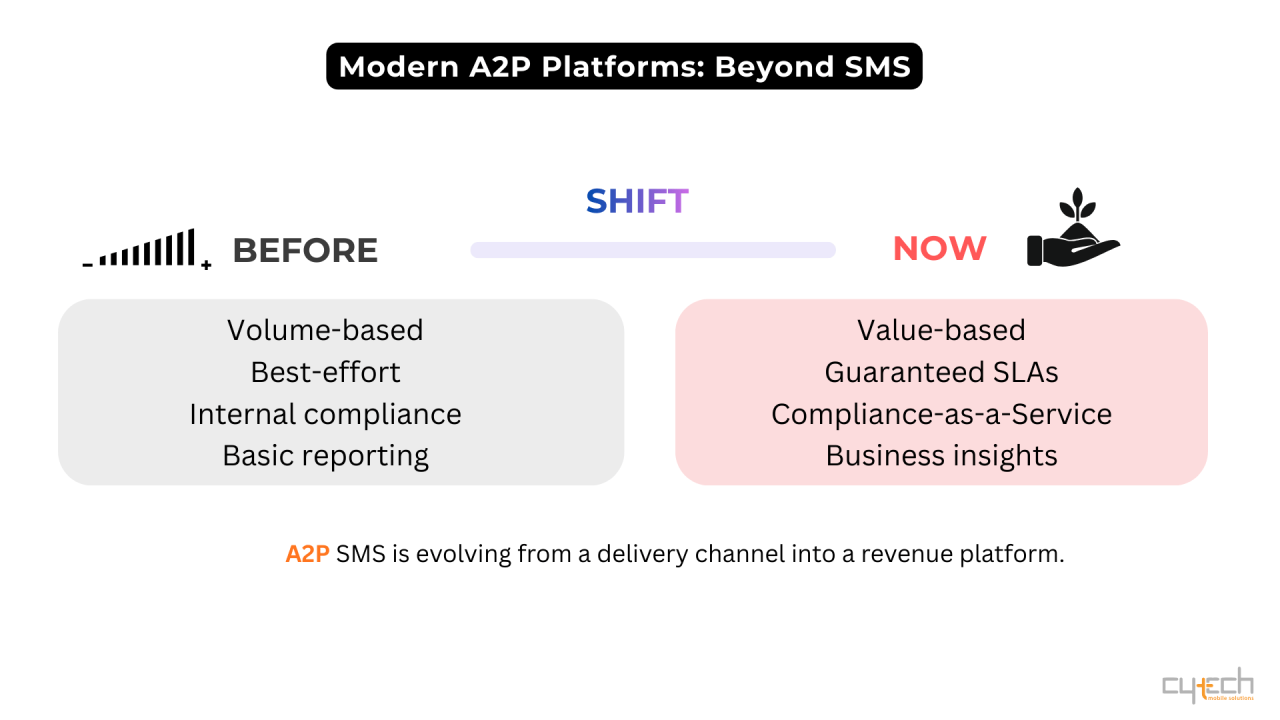
This shift is clearly illustrated by the contrast between traditional A2P models and today’s revenue-oriented platforms.
| Dimension | Traditional A2P (Cost Center) | Modern A2P (Revenue Platform) |
|---|---|---|
| Core offering | SMS delivery and routing | End-to-end business messaging services |
| Pricing logic | Price per message or volume | Value-based and service-driven pricing |
| Differentiation | Route quality and cost | Trust, SLAs, compliance, analytics |
| Sender IDs | Basic technical configuration | Verified and managed identities |
| Delivery model | Best-effort | Guaranteed SLAs and prioritization |
| Compliance | Internal cost and risk | Compliance-as-a-Service |
| Reporting | Basic delivery reports | Advanced analytics and business insights |
| Strategic role | Network operation | Revenue layer and business enabler |
This transformation is already taking place. It is redefining how leading providers position their A2P offerings and how enterprises choose their messaging partners.
Branded Sender IDs: Monetizing Trust and Identity
Few developments illustrate this transition as clearly as branded sender IDs.
What was once a simple technical parameter has become a central element of enterprise communication strategy. As messaging fraud continues to rise, end users increasingly rely on sender recognition to assess whether a message is legitimate.
At the same time, regulators and mobile networks have introduced stricter requirements for sender ID registration, verification, and ongoing monitoring.
Together, these factors create a clear commercial opportunity. Verified and managed sender IDs can be offered as premium services that include onboarding, validation, lifecycle management, and protection against misuse. Identity management shifts from an operational burden to a monetizable capability.
In practical terms, trust becomes a product.
Guaranteed Delivery SLAs: Reliability as a Commercial Offering
Not all A2P messages carry the same level of business criticality.
Messages such as one-time passwords, payment confirmations, and fraud alerts allow no margin for delay. Enterprises are fully aware of this reality and increasingly demand delivery guarantees.
This is where SLAs evolve from internal performance indicators into commercial offerings. Guaranteed delivery times, traffic prioritization, premium routing, and controlled retry mechanisms make it possible to create differentiated service tiers aligned with business-critical use cases.
Enterprises are no longer paying simply for message delivery. They are paying for certainty.
Compliance-as-a-Service: Turning Regulatory Burden into Business Value
Regulatory compliance has become one of the most complex challenges in the A2P environment.
Sender registration rules, content templates, opt-in requirements, data protection obligations, and country-specific regulations vary significantly across markets. For enterprises, managing this complexity internally is costly, risky, and inefficient.
Advanced A2P platforms address this challenge by embedding compliance directly into their operating model. Compliance-as-a-Service allows enterprises to transfer regulatory responsibility to the provider, supported by transparency, accountability, and continuous regulatory updates.
Compliance stops being an invisible cost and becomes a recurring value-added service.
Analytics and Reporting: From Traffic to Intelligence
Historically, A2P reporting focused on basic delivery metrics. Today, this level of visibility is no longer sufficient.
Enterprises expect granular insights across countries, routes, sender IDs, and time periods. They want to understand delays, retries, failures, and performance trends, and to connect messaging performance with customer experience and business outcomes.
Advanced analytics transform messaging from a background technical function into a decision-support capability. A2P platforms that deliver actionable insights elevate their role from technical vendors to strategic partners.
In this direction, Cytech has developed and released the 1st Business Intelligence tool specifically created for the messaging industry, mCore Dashboards. This BI tool comes as an extension of the mCore platform and gives immense capabilities of reporting and monitoring.
Before and now
Cytech’s Perspective: mCore as a Revenue-Driven Business Suite
At Cytech, this industry shift is directly reflected in the design philosophy behind mCore.
mCore is not a traditional SMS gateway. It has been built as a comprehensive A2P business platform that brings together monetization, compliance, analytics, billing, and operational control within a single environment.
Sender ID management, delivery SLAs, embedded invoicing, and advanced reporting are not optional extensions. They are foundational components of the platform, enabling service providers to treat A2P not as a network expense, but as a structured and scalable revenue layer.
The Next Chapter of A2P
A2P SMS is not disappearing. It is evolving.
The future belongs to platforms that go beyond basic delivery and invest consistently in value creation. For service providers prepared to make this transition, A2P is no longer just part of the network.
It becomes a core element of business strategy and a sustainable engine for long-term growth.