


Table of Contents
Low-code platforms allow applications to be built using visual tools and pre-configured components, dramatically accelerating delivery and lowering the barrier to entry. As businesses face increasing pressure to innovate faster, adapt continuously, and operate with limited technical resources, low-code has gained strong momentum. At the same time, custom development continues to play a critical role for complex, large-scale, and mission-critical systems.
Rather than competing approaches, low-code and custom development represent two ends of a strategic spectrum. Understanding their strengths and limitations is essential for making informed technology decisions. This article explores both approaches, compares them across key dimensions, and provides practical guidance on when to choose one over the other.
What Are Low-Code Development Platforms?
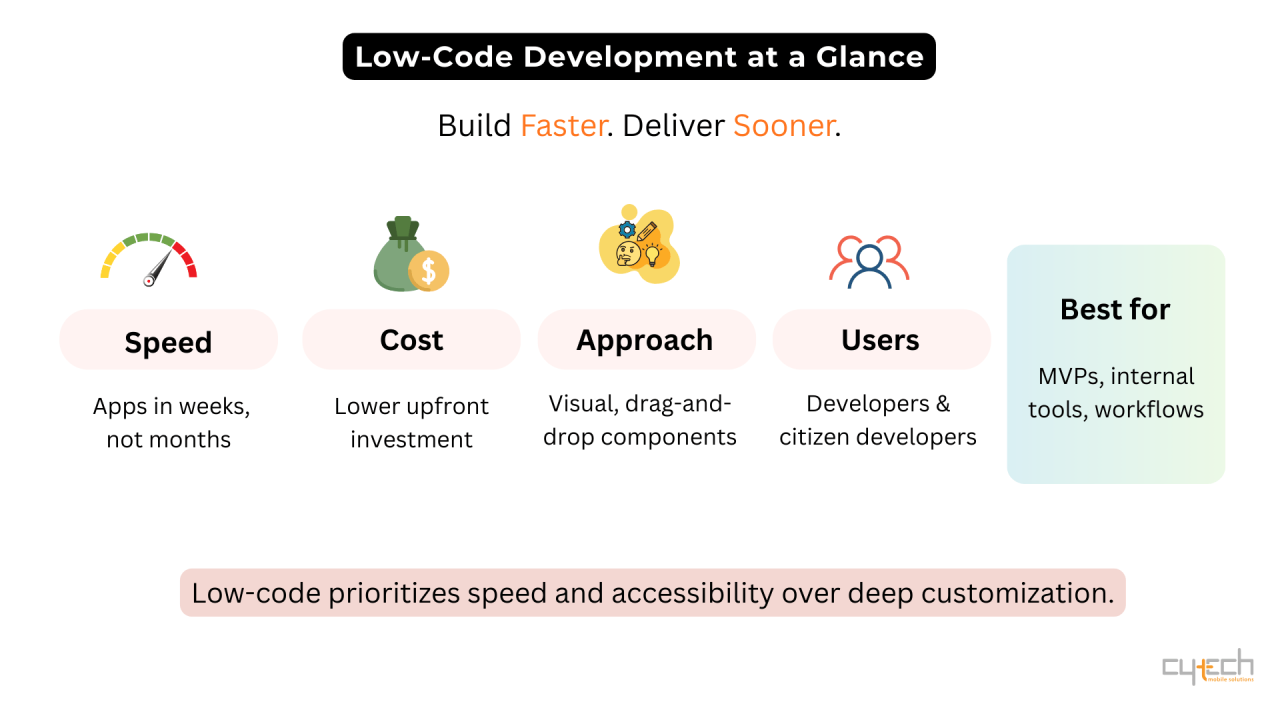
Low-code development platforms are environments that enable the creation of applications through graphical interfaces, drag-and-drop components, and pre-built modules, with minimal manual coding. Common functionalities such as forms, workflows, database connections, and integrations are already implemented and can be assembled visually.
The core value of low-code lies in abstraction. Instead of writing repetitive boilerplate code, users focus on defining business logic and process flows. This makes development faster and more accessible, allowing not only professional developers but also business analysts, operations teams, and so-called “citizen developers” to participate in application creation.
While most low-code platforms allow custom code extensions when needed, their primary goal is to reduce development effort and time-to-market. The trade-off is that flexibility is partially constrained by what the platform supports. In essence, low-code prioritizes speed and ease of use over unlimited customization.
What Is Custom (Traditional) Software Development?
Custom development, often referred to as traditional or “high-code” development, involves building software from the ground up using general-purpose programming languages and frameworks. Architecture, business logic, user interfaces, and integrations are all implemented through hand-written code.
This approach offers maximum flexibility and control. Applications can be tailored precisely to business requirements, performance needs, and long-term strategic goals. However, this level of control comes with higher costs, longer timelines, and the need for experienced development teams.
Custom development remains the preferred choice for complex systems, core digital products, and applications where scalability, security, or differentiation is critical. It is less about speed and more about precision, robustness, and long-term sustainability.

Speed of Development
Speed is one of the most significant advantages of low-code development. By leveraging pre-built components and visual design tools, teams can deliver functional applications in weeks rather than months. Rapid prototyping and fast iteration cycles make low-code especially attractive for MVPs, internal tools, and time-sensitive initiatives.
Changes can often be made directly through configuration rather than code rewrites, enabling quick adjustments in response to feedback or evolving requirements. This agility is particularly valuable in fast-moving business environments.
Custom development, by contrast, is inherently slower. Writing, testing, and maintaining custom code takes time, especially when best practices and quality standards are followed. While modern frameworks help streamline development, custom projects typically prioritize architectural soundness and long-term reliability over immediate delivery.
Cost and Financial Considerations
Low-code platforms generally offer lower upfront costs. Reduced development time, fewer specialized engineers, and the ability to reuse platform components make them accessible for organizations with limited budgets. For small and mid-sized companies, low-code can make application development feasible where traditional development might be cost-prohibitive.
However, low-code platforms usually involve recurring subscription or licensing fees. As usage grows — more users, more data, more integrations — ongoing costs can increase. Over time, these expenses may rival or exceed the cost of a custom-built solution.
Custom development requires a higher initial investment, driven by engineering effort and longer timelines. Yet once built, the organization owns the code outright. There are no mandatory platform fees, and long-term operational costs can be lower, especially for applications that are central to business operations.
Scalability and Flexibility
Low-code platforms are well suited for standard applications with predictable requirements, but they have inherent limitations. Customization is restricted to the capabilities provided by the platform, and implementing unconventional features may be difficult or impossible without workarounds.
Scalability is another consideration. While many low-code platforms support moderate growth, performance and scalability depend on the platform’s underlying architecture. Large-scale or high-throughput applications may encounter limitations beyond a certain point.
Custom development offers full flexibility. Architects can design systems specifically for scale, performance, and resilience, selecting databases, infrastructures, and optimization strategies that align with anticipated growth. Integrations with legacy systems or specialized technologies are also more straightforward, as there are no platform constraints.
Maintenance and Technical Ownership
Low-code applications often benefit from simplified maintenance. Platform providers handle infrastructure, updates, and many technical concerns, reducing the operational burden on internal teams. Minor changes can often be managed by non-technical users through configuration.
The downside is dependency on the vendor. Platform updates, pricing changes, feature deprecations, or service disruptions are outside the organization’s control. This dependency extends to long-term viability and strategic flexibility.
Custom-developed software requires internal responsibility for maintenance, security patches, and system evolution. While this demands stronger technical capabilities, it also grants full autonomy. Organizations decide when and how to upgrade, refactor, or extend their systems, without external constraints.
Required Technical Skills
Low-code significantly lowers the technical barrier to entry. Business users with domain knowledge can contribute directly to application development, reducing reliance on scarce engineering talent. This democratization of development is particularly valuable for internal tools and process automation.
That said, effective low-code use still requires technical understanding. Users must grasp data models, logic flows, and platform limitations. More complex low-code projects often benefit from at least one experienced developer overseeing architecture and extensions.
Custom development, on the other hand, demands professional engineering expertise. Skilled developers, architects, testers, and DevOps specialists are essential to ensure quality, security, and scalability. Without the right talent, custom projects risk delays, cost overruns, or technical debt.
| Criterion | Low-Code Development | Custom Development |
|---|---|---|
| Development Speed | Very fast – applications delivered in weeks | Slower – development typically takes months |
| Upfront Cost | Low to moderate | High |
| Long-Term Cost | Ongoing platform licenses and usage fees | No vendor fees; maintenance costs only |
| Flexibility & Customization | Limited to platform capabilities | Full control and unlimited customization |
| Scalability | Suitable for small to mid-scale applications | Designed for large-scale, high-performance systems |
| System Integrations | Standard connectors; limitations for niche systems | Unlimited integrations via custom code |
| Maintenance | Simplified; largely handled by the platform provider | Fully managed by internal or contracted teams |
| Vendor Lock-In | High dependency on platform provider | None – full ownership of source code |
| Required Technical Skills | Lower; accessible to citizen developers | High; requires experienced software engineers |
| Ideal Use Cases | MVPs, internal tools, workflows, rapid prototypes | Core products, mission-critical systems, complex platforms |
When to Choose Low-Code and When to Choose Custom Development
Low-code is best suited when speed, cost efficiency, and simplicity are top priorities. Internal applications, workflow automation, departmental tools, and MVPs are ideal candidates. It is also a strong choice when development resources are limited or rapid experimentation is required.
Custom development is the right choice for applications that are central to business strategy, require high scalability or performance, or involve complex integrations and strict security or compliance requirements. In these cases, the flexibility and control of custom code outweigh the higher upfront investment.
Many organizations adopt a hybrid approach — using low-code for rapid delivery where possible and custom development for core or highly specialized components. This combination can balance speed with long-term robustness.
Conclusion
Low-code and custom development are not mutually exclusive; they are complementary tools within a modern software strategy. Low-code empowers organizations to move quickly and innovate with fewer resources, while custom development delivers the flexibility, scalability, and control required for complex and mission-critical systems.
The key is alignment. By evaluating project scope, timeline, budget, complexity, and long-term objectives, organizations can choose the right approach — or combination of approaches — for each initiative. In an environment where adaptability is a competitive advantage, having multiple development options is not just convenient; it is strategic.