

Table of Contents
The interplay between these two ecosystems — traditional messaging and OTT — defines the present and future of mobile communication. The key question is not whether one will displace the other, but how both can coexist, compete, and evolve to serve individuals, enterprises, and entire industries.
The Rise of OTT Apps
OTT messaging applications have transformed how people communicate. Offering free text, voice, and video over the internet, they gained global dominance by providing features far beyond simple text. Group chats, file sharing, stickers, voice notes, and encryption created highly engaging, sticky ecosystems.
Key drivers of OTT adoption include:
- Cost-efficiency: Users avoid per-message SMS fees by relying on data or Wi-Fi.
- Feature-rich environments: Multimedia messaging, reactions, and integrated services.
- Network effects: The more friends and communities migrate, the stronger the pull.
- Security and privacy: Many OTT apps market end-to-end encryption as a core feature.
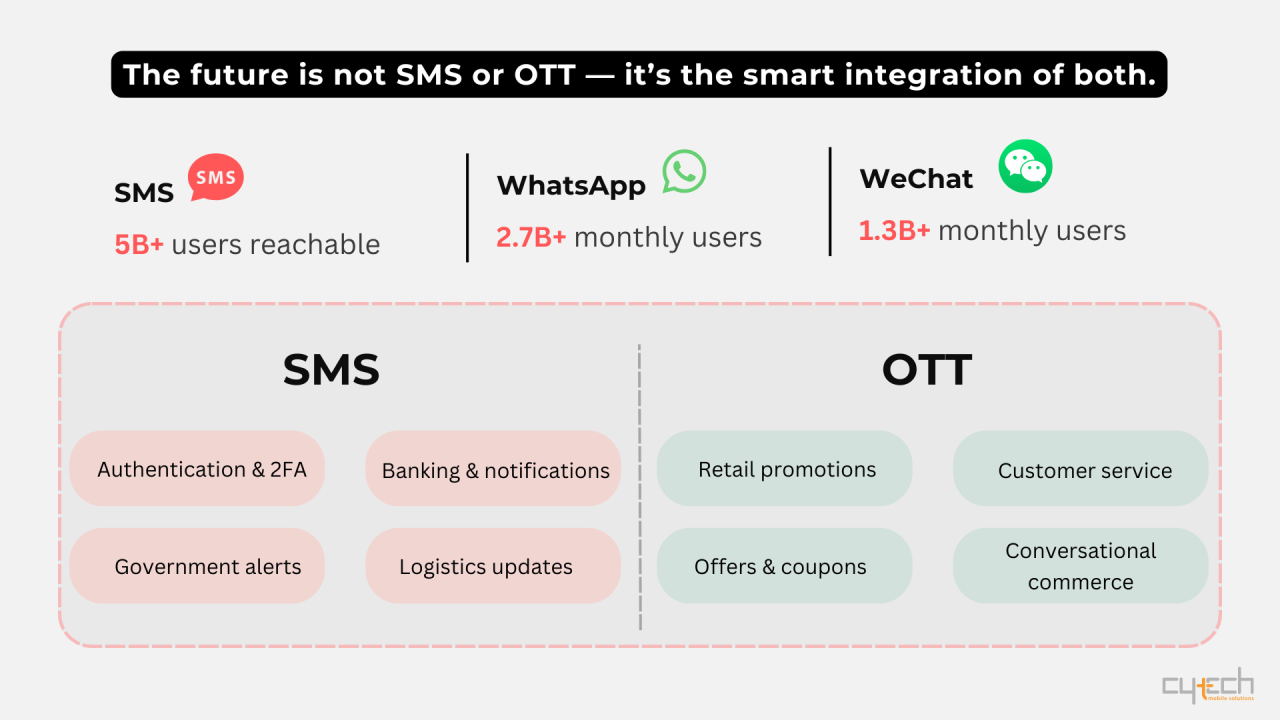
The result is striking: WhatsApp alone surpasses 2.7 billion monthly active users globally, while WeChat dominates in China with over 1.3 billion users.
The Enduring Power of SMS
Despite OTT dominance in consumer-to-consumer communication, SMS continues to thrive, particularly in enterprise and mission-critical contexts. Reasons include:
- Ubiquity: Every mobile phone, smart or basic, supports SMS. No app download or internet connection required.
- Reliability: SMS works even in low-bandwidth or poor network conditions.
- Reach: Telcos can deliver SMS across borders without dependency on user choices.
- Trust: SMS remains a trusted channel for authentication, alerts, and critical updates.
The numbers tell the story: the A2P (Application-to-Person) messaging market is projected to exceed $70 billion by 2030, driven by two-factor authentication (2FA), banking alerts, delivery notifications, and government communications.
For businesses, SMS remains the gold standard when guaranteed reach and immediacy matter more than rich media.
Coexistence and Competition
Rather than framing OTT and traditional messaging as a zero-sum game, the industry increasingly recognizes complementary roles. The choice of channel depends on context, audience, and purpose.
- Enterprises diversify channels. Businesses adopt an omnichannel strategy, combining SMS, OTT, email, and push notifications to ensure coverage and maximize engagement.
- Telcos adapt with RCS. Rich Communication Services (RCS), promoted as “SMS 2.0,” offers multimedia features natively within messaging apps on smartphones. Though adoption has been uneven, it represents telcos’ effort to compete directly with OTT.
- OTT moves into enterprise space. WhatsApp Business API and Viber for Business provide official channels for customer engagement, often competing with SMS in retail, banking, and customer service.
Consumers drive the balance. End-users increasingly expect seamless, context-aware communication. They don’t think in terms of “OTT vs SMS”—they expect brands to reach them where they are.
Comparative Overview: OTT vs. Traditional Messaging
| Aspect | Traditional Messaging (SMS/A2P) | OTT Messaging (WhatsApp, Viber, etc.) |
|---|---|---|
| Reach | Universal, works on all phones | Limited to app users (though often in the billions) |
| Cost | Typically per message, billed via telcos | Free for consumers, businesses often pay API costs |
| Features | Text-based, 160 characters (with limited extensions) | Rich media, voice, video, stickers, encryption |
| Reliability | High, works on poor networks, no app needed | Dependent on data/Wi-Fi and app availability |
| Trust & Security | High trust, but limited encryption | End-to-end encryption, but occasional data privacy concerns |
| Enterprise Use | Banking, 2FA, alerts, government, logistics | Customer service, retail promotions, conversational commerce |
| Regulation | Strongly regulated by telcos and authorities | Less regulated, but increasingly under scrutiny |
| Future Outlook | RCS, deeper integration with telco services | Expansion of business APIs, super-app ecosystems |
What’s Next?
The future of messaging will be defined not by the dominance of one channel, but by the seamless integration of many. Several trends are worth highlighting:
1. Omnichannel Messaging Becomes the Standard
Businesses will increasingly adopt platforms that aggregate SMS, OTT, and email, routing messages intelligently based on user preferences and regional dynamics. For example, a customer in Europe may prefer WhatsApp notifications, while another in rural Africa is best reached via SMS.
2. Growth of Conversational Commerce
OTT apps are rapidly evolving into platforms where discovery, engagement, and transactions happen inside the chat itself. WhatsApp Pay, Viber Pay, and WeChat Pay illustrate how messaging apps can double as commerce hubs. SMS is less suited here but remains the reliable notification backbone.
3. Telcos’ Countermove with RCS
If widely adopted, RCS could bridge the gap by providing app-like experiences within native messaging. However, its global rollout depends heavily on telco coordination and device manufacturer support.
4. Security and Trust as Differentiators
With rising cybersecurity threats, the trust factor becomes paramount. SMS is still favored for critical authentication due to its ubiquity, but OTT providers are investing in advanced encryption and fraud prevention. Future winners will be those who maintain both functionality and trustworthiness.
5. AI-Driven Messaging Experiences
Both OTT and telco-based messaging are evolving towards AI integration. Chatbots, smart replies, and predictive engagement are becoming the norm. Whether via SMS or WhatsApp, businesses will leverage AI to personalize interactions at scale.
Conclusion: A Future of Integration
The battle between OTT apps and traditional messaging is less about replacement and more about balance. SMS continues to dominate mission-critical and authentication use cases, while OTT applications shape interactive, media-rich consumer engagement.
For enterprises, the challenge is not to pick a single channel but to orchestrate them intelligently. Telcos, OTT players, and technology providers all play a role in building this integrated future. The next decade of messaging will be defined by interoperability, trust, and user-centric design — not by who “wins” the battle, but by how the ecosystem evolves together.
In the end, consumers and businesses alike will benefit from a landscape where SMS reliability meets OTT richness, underpinned by AI, security, and cross-channel intelligence.