

Table of Contents
GitOps is no longer just a buzzword — it is reshaping how engineering teams build, deploy, and manage systems. At its core, it is simple: everything that defines your application and infrastructure lives in Git. Every change flows through commits and pull requests, and automated systems ensure that what runs in production always reflects what’s written in the repository.If we had to summarize it in one sentence: If it’s not in Git, it doesn’t exist.
How it Emerged
GitOps didn’t appear out of thin air. It evolved naturally from Infrastructure as Code (IaC) and DevOps workflows. The declarative nature of Kubernetes made it a perfect match for GitOps, allowing early adopters to store manifests, configuration files, and policies in Git while automated agents kept their clusters aligned with the repository.
Over time, it moved beyond Kubernetes. It now applies to cloud infrastructure, databases, multi-cloud environments, and full CI/CD pipelines. What started as a clever tooling pattern has become a broader philosophy: treat everything as code, and let automation handle the rest.
How it Changes the CI/CD Model
The most impactful shift GitOps introduces is the deployment pattern. Traditional CI/CD pipelines push updates directly into environments using scripts, credentials, and manual logic. It
flips the model.
After CI finishes, the desired state is written to Git — and then a GitOps agent (like Argo CD or Flux) automatically pulls those changes into the environment.
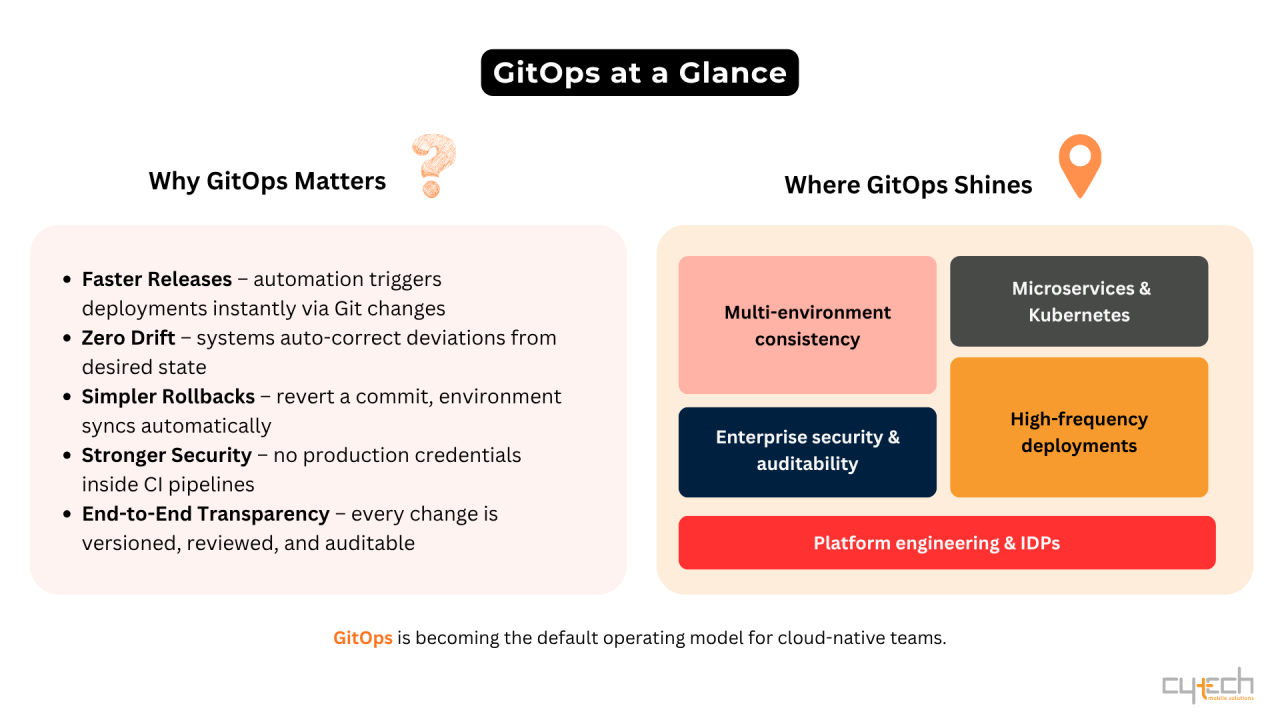
This pull-based model reduces human error, standardizes deployments, and eliminates configuration drift. Rollbacks become as simple as reverting a Git commit. Audit trails become built-in. And production environments become more predictable and stable.
A Quick Comparison: GitOps vs Traditional CI/CD
Below is a clean comparison illustrating why it is gaining so much momentum:
| Category | Traditional CI/CD | GitOps |
|---|---|---|
| Deployment Model | Push-based — pipelines push changes into production | Pull-based — the environment pulls changes from Git |
| Source of Truth | Scripts, tools, pipeline logic scattered across systems | A single, authoritative Git repository |
| Operational Style | Imperative (step-by-step instructions) | Declarative (desired end state) |
| Security Approach | CI/CD pipelines often require production credentials | Only the GitOps agent needs access, and it’s minimal |
| Auditability | Logs vary by tool and may be inconsistent | Full version history via Git commits |
| Rollback Process | Manual, error-prone, requires re-running scripts | Instant: revert a commit and auto-sync |
| Protection Against Drift | Environments often diverge over time | Continuous reconciliation ensures consistency |
Why it Has Become So Popular
The rapid adoption of GitOps is driven by very real operational benefits. With one unified source of truth, collaboration becomes smoother and confusion drops dramatically. Security improves because every change must pass through PR reviews. Deployments accelerate because humans no longer need to manually initiate production updates.
Teams report fewer incidents, easier debugging, and faster onboarding because developers use the same tools for both code and infrastructure. Ops teams gain clearer visibility and drastically reduce time spent fighting inconsistencies between environments.
GitOps brings predictability — and predictability is everything in modern software delivery.
The Ecosystem Powering GitOps
GitOps didn’t rise alone. It is backed by a mature set of tools:
- Argo CD: A widely adopted Git-Ops CD tool with a polished UI and strong Kubernetes support.
- Flux: Lightweight, modular, and deeply integrated into cloud-native platforms.
- CI Pipelines (GitHub Actions, GitLab CI): These systems trigger Git-Ops flows by updating configs in Git.
- Terraform and IaC: Enabling Git-Ops for cloud resources beyond Kubernetes.
- Policy-as-Code (OPA, Kyverno): Automatically enforcing compliance and security within the Git-Ops workflow.
Even small teams can now adopt GitOps with minimal friction and expand their setup over time.
Where it Is Heading
GitOps is on track to become the default approach for cloud-native delivery. Surveys show that more than 77% of organizations use its practices in some form today. Platform engineering teams rely on it to power Internal Developer Platforms. Multi-cloud and edge environments increasingly depend on GitOps for consistency.
The ecosystem is evolving toward:
- Git-Ops-as-a-Service offerings
- More intuitive dashboards
- Deeper integrations with cloud providers
- AI-assisted Git-Ops (e.g., detecting drift, suggesting patches, validating configurations)
The future of infrastructure automation is declarative, self-correcting, and deeply intertwined with GitOps principles.
Conclusion
GitOps marks the next major chapter in the evolution of CI/CD. By placing Git at the center of operations, teams gain reliability, visibility, speed, and a healthier engineering culture. It minimizes complexity, reduces risk, and turns delivery pipelines into predictable, auditable systems that scale.
As cloud-native systems continue to expand, it stands out as a method that teams can trust — not just for better deployments, but for building a more stable and future-ready engineering foundation.
Simply put: GitOps isn’t just a trend. It’s a transformation. And it’s here to stay.