


Table of Contents
At this point, the most dangerous cycle begins: assumptions, blind changes, temporary fixes, and releases made more out of hope than knowledge. Software development stops being an engineering discipline and becomes a guessing game if not built with Observability in mind.
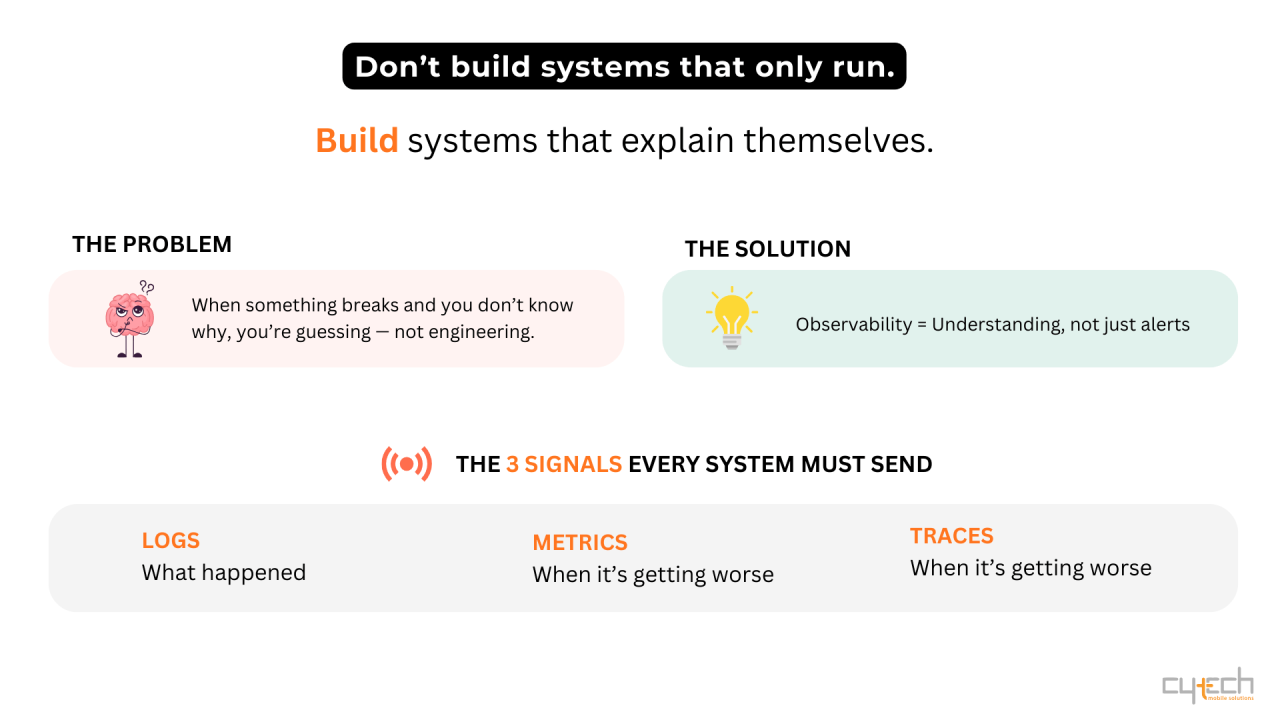
A system that cannot explain its own behavior is like a vehicle without dashboards. It may still move, but you are driving in the dark.
What It Really Means to “See” Inside a System
Knowing that something has “gone down” is not the same as understanding it. A truly transparent system does not just notify you when something is wrong; it shows you what caused it, how it evolved, and which components are affected. The difference is not technical—it is cognitive. You move from “something is wrong” to “this is exactly what is happening here, and for this reason.”
In such an environment, teams stop operating on assumptions and start operating on evidence. Conversations are no longer based on suspicion but on facts. The system becomes a source of knowledge rather than a source of stress.
Real visibility does not only show the present; it reveals trends. It warns you when something is starting to drift before the situation becomes irreversible. Intervention becomes preventive rather than reactive.
The system transforms from a “black box” into a tool for understanding and control.
The Three Vital Signs of Every Healthy System
A system cannot “speak” if it leaves no traces. Insight only emerges when data is collected in a structured and consistent way. It is not enough to record events; they must be meaningful. There are three fundamental ways a system describes its behavior over time.
Logs act as a historical record of events. They do not simply state that something happened, but what happened, where, and under what conditions. When written correctly, they lead you directly to the problem. When written poorly, they confuse you more than they help you.
Metrics capture the system’s “pulse.” They show when something is getting overloaded, when a subsystem is under pressure, or when a process begins to deviate from normal behavior.
Finally, traces reveal the journey of each request across the application’s ecosystem, showing exactly where time or reliability is lost.
| Data Type | What it gives you in practice |
|---|---|
| Logs | What happened and where |
| Metrics | When something is getting worse |
| Traces | Where exactly it gets stuck |
Why It Must Be Designed from the Start
Adding transparency to a system after it has reached production is like trying to install navigation equipment on a ship that is already at sea. You have no historical data and no clear sense of what “normal” looks like. Every metric seems suspicious and every alert questionable.
In practice, this leads to fragmented solutions. One metric added in haste, a few logs without structure, a dashboard full of numbers with no context. What you gain is an illusion of control—not real understanding.
When transparency is built into the system from day one, however, the software grows with self-awareness. Metrics reflect real needs, data follows coherent patterns, and anomalies are detected early.
Observability is not a “feature.” It is a foundation.
It’s Not Monitoring. It’s Understanding.
Monitoring answers the question: what happened?
Observability answers the question: why did it happen?
Many systems alert you when something critical occurs—an error, a crash, a failed request. Something went down. Something stopped responding. Something crossed a threshold. And that is where information ends. You get a signal, but no explanation.
Observability works differently. It connects symptoms, root causes, and impact. It does not merely tell you that there is a problem; it shows what caused it and which parts of the system are affected. The system stops being an alert machine and becomes a tool for comprehension.
Without monitoring, you may never see the problem.
Without observability, you will never understand it.
It’s a Mindset, Not a Toolset
The most common mistake is believing that the problem can be solved by installing another tool. A dashboard, an alerting system, or a data platform alone does not create clarity. It simply produces more data.
Real change begins when the team’s philosophy changes. When logs are written for humans, not just machines. When metrics are defined not only by technical thresholds but by real user experience. When decisions are made from evidence, not from assumptions.
In such a culture, “maybe” is replaced by “it shows here.” Uncertainty gives way to confidence based on understanding.
Observability is not enforced through installation guides. It is built through daily practices, shared language, and collective responsibility.
How to Design a System That “Speaks”
Good design does not start with technology but with the question: when do things go wrong? The answer is not only about servers and CPU usage, but about what the user experiences. A system may be technically resilient and yet functionally broken.
Designing an expressive system rests on simple principles:
- it records clearly,
- measures meaningfully,
- reveals flows,
- and exposes delays.
Dashboards are not meant to impress; they are meant to answer questions. Every chart should tell a story. Every number should have meaning.
The team must speak the same language: what counts as an error, what defines latency, what success actually means. When everything is clearly defined, everything is easier to interpret.
If a third person cannot understand a metric, then in practice it does not exist.
When There Is No Visibility
A system without real insight creates a daily reality filled with uncertainty. Changes are made in fear, because no one knows with confidence how the system will react. The same problems resurface repeatedly, without the root cause ever being addressed. Knowledge becomes concentrated in a few individuals—usually those who “happened” to live through past failures. Over time, the team becomes exhausted, not just technically but psychologically.
With true observability, the environment changes radically. Problems are detected before they escalate, decisions are made calmly, and knowledge is shared. The system no longer intimidates; it builds trust.
Observability does not only increase performance. It changes how the entire team works.
A Side-by-Side View
| Dimension | System without Observability | System with Observability |
|---|---|---|
| Visibility | Blurred or absent | Real-time, complete |
| Problem handling | Reactive | Preventive |
| Fault response | Guesswork and trial | Data-driven |
| Behavioral understanding | Limited | Holistic |
| Information flow | Fragmented | Unified |
| Decision-making | Intuitive | Evidence-based |
| Design approach | Added later | Built-in |
| Team experience | Stress and uncertainty | Confidence |
| Knowledge | Concentrated | Shared |
| System resilience | Fragile | Robust |
| User experience | Unpredictable | Stable and controlled |
| Culture | “Firefighting” | “Prevention” |
Closing: Don’t Build Silent Systems
Modern software must do more than work. It must explain itself. It must show when it is under pressure, when it is approaching its limits, and when it begins to drift away from normal behavior—not when it is already too late, but while there is still time to intervene.
Observability is not a luxury for large teams or complex systems. It is a fundamental requirement for any team that wants to understand what is truly happening inside its product. This is not only about faster debugging. It is about maturity in software engineering.
The real advantage is not avoiding mistakes. It is understanding why they happened and making sure they do not return. As systems grow more complex, the ability to “read” them becomes essential.
Do not build software that merely runs.
Build software that explains itself.
And then, the next time something goes wrong, you will not search in the dark. You will know where to look—and more importantly—you will know what you are seeing.