


Table of Contents
In the United States alone, over 6 billion SMS messages are exchanged daily — a number so vast it’s almost meaningless on its own (source). Globally, the scale is staggering: WhatsApp, with more than 2.5 billion users, is estimated to process close to 100 billion messages every single day (source).
For most of us, messaging is a given — reliable, fast, and always there. But behind this seamless experience lies an unseen world of code, servers, and human dedication. Few stop to think about the people who make it all work.
The Hidden Scale of Messaging
Imagine a stage where the actors are servers, not people — a backstage network stretching across continents. One major messaging provider describes its infrastructure as “a sprawling, complex system of servers, cables, and code,” capable of processing up to 10 billion messages per day (source). That setup includes 61 data centers, 40,000 virtual machines, and over a thousand physical servers, all humming in unison to keep global communication flowing.
Every second, these systems encrypt messages, route notifications, and confirm deliveries. If even a fraction of that machinery stutters, millions could lose touch — a reminder that reliability is never accidental. Engineers design each component to stand alone, so that a single failure doesn’t ripple across the entire platform.What’s even more surprising is that this global infrastructure is often maintained by relatively small teams. At one point, WhatsApp’s massive messaging operation — handling tens of billions of messages daily — was run by around 50 backend engineers (source). Behind every app icon are people quietly watching dashboards, writing code, and making changes that affect millions, often in real time.
Building the Backbone
Who exactly keeps this machinery alive?
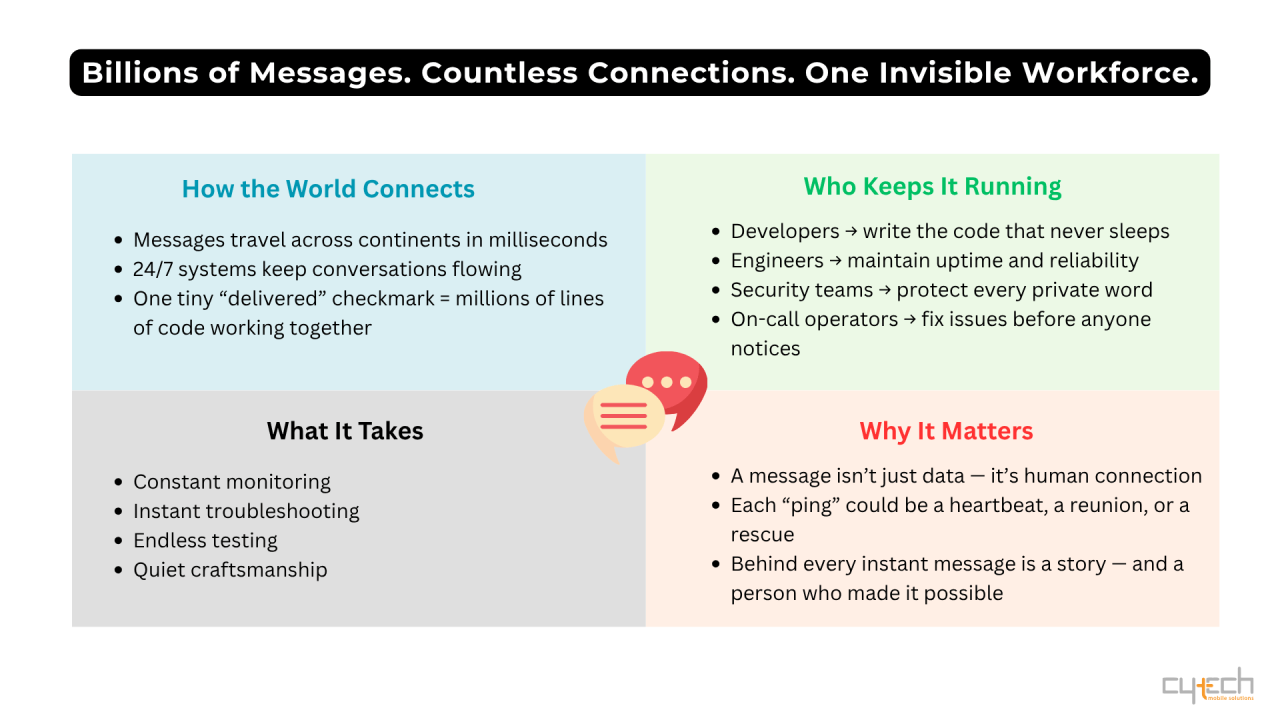
They’re software developers, network engineers, site-reliability experts, database admins, and QA testers — each with a specialized role but a shared mission: keep the world connected.
They deal with legacy telecom protocols, negotiate with carriers, and integrate with cloud services while ensuring security and scalability. For every visible feature — read receipts, group chats, end-to-end encryption — someone had to solve countless invisible problems to make it work everywhere, instantly.
Messaging never sleeps. When an outage happens in the middle of the night, these teams wake up. They debug, patch, and redeploy — all so that a birthday wish, payment confirmation, or emergency alert gets delivered on time. Many describe the work as a mix of adrenaline and satisfaction: seeing an error flood turn into a “green” status again after hours of problem-solving.
It’s not glamorous. There’s no applause. But for these engineers, that little check-mark beside “Delivered” is a silent reward.
Challenges and Ingenuity
Maintaining global messaging is a constant exercise in balance and creativity. Systems must be built not just to work — but to fail gracefully. Hardware malfunctions, sudden surges in traffic, or a stray memory leak can bring an entire data center down.
In one case, a simple bug in a network switch caused multiple backup data centers to crash simultaneously. The engineers working through the night didn’t just fix the issue; they redesigned their infrastructure afterward, separating storage layers, adding redundancy, and even scheduling weekly “disaster drills.” Every incident became a learning opportunity, turning setbacks into blueprints for resilience.
Sometimes the challenges are about scale rather than failure. When one provider faced a flood of billions of emails from a major client campaign, engineers had hours to act. Instead of waiting for new servers, they improvised — spinning up dozens of cloud instances and rerouting attachments through cloud storage. It worked flawlessly. That kind of quick thinking — a blend of logic and creativity — defines the culture behind modern messaging systems.
A Snapshot of Scale
| Metric | Approximate Figure | What It Means |
|---|---|---|
| Global SMS traffic | 23 trillion per year | About 730,000 messages every second |
| WhatsApp daily messages | 100 billion | Equal to 12 messages per person on Earth |
| Average backend team size (major app) | ~50 engineers | Each responsible for billions of messages |
| Typical data centers | 60+ | Operated 24/7 for reliability and latency |
| Message delivery latency | < 1 second | Human-level “instant” responsiveness |
Security, Privacy, and Precision
Modern messaging platforms are guardians of both speed and trust. Implementing end-to-end encryption means that even the engineers can’t read user content — which makes debugging especially challenging. They must trace issues blind, relying on metadata and system logs without ever peeking into private exchanges.
Spam filters, abuse detection systems, and encryption keys must be updated across millions of devices, all while keeping latency near zero. Each change, however small, is tested, rolled out, monitored, and tweaked — sometimes several times a day.Behind all this is a quiet philosophy: reliability is not just technical performance, it’s a matter of human trust. A safe password reset, a medical appointment alert, or a family group chat — these are personal moments that depend on invisible infrastructure working perfectly.
The Human Side of Code
The people behind messaging systems are as diverse as the messages themselves. Some code late at night in small offices; others monitor global traffic in massive operations centers. They might sit continents apart, yet they’re connected by the same rhythm — a heartbeat of uptime, metrics, and alerts.
Their work language may be technical — TCP sockets, latency budgets, queues — but their motivation is deeply human. Many keep photos of loved ones nearby as a reminder of what their work enables: a dad receiving a newborn’s photo, a student submitting an assignment, a doctor confirming an appointment.
As one developer once said:
“Building messaging isn’t just writing code — it’s building trust, packet by packet.”
They may never get public recognition, but their fingerprints are on every “good morning,” every two-factor code, every moment of connection that happens online.
Every Message Matters
For the average user, a message is fleeting — but for those who build the systems, every one of them tells a story.
A birthday wish, a rescue alert, a payment confirmation: all travel across networks designed and maintained by people who rarely get credit.
This awareness shapes how these teams work. When systems fail, they don’t just patch and move on; they write post-mortems, share lessons, and redesign for the future. After one major outage in Frankfurt, engineers restructured their global deployment so that new data centers could be launched instantly in the cloud — turning a past failure into a future advantage.
For them, every crisis is a classroom. Every fix, a new standard. This continuous evolution is what keeps global messaging dependable — even when billions of messages are sent in the blink of an eye.
Invisible Craftsmanship
It’s easy to take messaging for granted, but it represents one of the greatest feats of human coordination in the digital age. Behind each instant delivery lies a blend of mathematics, empathy, and endurance.
The people maintaining these systems don’t seek fame. They measure success in milliseconds, uptime percentages, and quiet satisfaction when everything “just works.” Their craft is invisible — but its impact is universal.
The next time your phone buzzes with a message, remember that somewhere, someone ensured it got through. You’ll never know their names. But their work connects the world — one packet at a time.Because in the end, building messaging systems is more than technology.
It’s about keeping humanity in sync — a quiet act of everyday heroism that deserves its moment of recognition.